
If you already have a 10 to 20 percent down payment and stable income, a traditional mortgage almost always costs less over time. If you lack that upfront capital, or need a documented payment history before a bank will approve you, rent-to-buy works as a strategic bridge rather than a permanent alternative. Both routes are legitimate, regulated paths to ownership in Italy, and the right one depends less on preference and more on your bank statement.
- Mortgage-ready buyers: stable contract, savings for the down payment and closing costs, and no urgency to move in before financing clears.
- Rent-to-buy candidates: limited liquidity, a need to build creditworthiness, or a desire to lock a purchase price while sorting out financing.
The legal backbone for rent-to-buy sits in Decreto Legge 133/2014, converted into Legge 164/2014, and both the Consiglio Nazionale del Notariato and the Agenzia delle Entrate have issued detailed guidance on how these contracts must be structured and taxed.
Key Takeaways
A mortgage typically costs less over the long run for buyers with a down payment and stable credit, while rent-to-buy works best as a documented bridge toward eventual financing.
| Point | Details |
|---|---|
| Verdict depends on liquidity | Mortgages suit buyers with 10 to 20% down payment ready; rent-to-buy suits those still building savings or credit. |
| Transcription is protection | Registering the rent-to-buy contract in the Conservatoria shields your price credit for up to ten years. |
| Payment split must be precise | Vague allocation between usage and price risks tax reclassification under Agenzia delle Entrate rules. |
| Price credit lowers future LTV | Accumulated imputazione a prezzo reduces the loan-to-value ratio if you need a mortgage later. |
| Notary review reduces risk | Notaryinitaly reviews contract clauses and coordinates transcription, escrow, and bank steps for foreign buyers. |
Table of Contents
- What Is Rent-to-Buy (Affitto Con Riscatto) Under Italian Law?
- How Should a Rent-to-Buy Contract Be Structured?
- How Does a Traditional Mortgage Work in Italy?
- Rent-to-Buy vs Mortgage: A Side-by-Side Look
- Which Option Fits Your Situation?
- What Are the Practical Steps and Costs in Italy?
- A €200,000 Property Over 36 Months: The Numbers
- How Notaryinitaly Helps You Choose With Confidence
- Where to Verify These Rules Yourself
- Frequently Asked Questions
- Sources
What Is Rent-to-Buy (Affitto Con Riscatto) Under Italian Law?
Rent-to-buy, formally known as affitto con riscatto, is a unitary contract combining immediate occupancy with a future option to purchase. Article 23 of D.L. 133/2014 created this instrument specifically to help buyers who cannot immediately access a mortgage still move toward ownership on defined terms.
The contract splits every monthly payment into two components: godimento (payment for using the property, functionally rent) and imputazione a prezzo (the portion credited toward the eventual purchase price). The Consiglio Nazionale del Notariato requires both percentages to be specified explicitly in the notarized contract, not left vague or negotiated informally later.
- Contracts commonly run over a number of years, though terms vary by agreement.
- Transcription in the Conservatoria gives the buyer protection against third-party claims for up to ten years, according to ADICU.
- The purchase price is locked at signing, insulating the buyer from market appreciation during the contract term.
That transcription is what separates rent-to-buy from an ordinary lease. A regular rental agreement offers no path to ownership and no price protection; rent-to-buy does both, provided the contract is properly registered.
How Should a Rent-to-Buy Contract Be Structured?
The economics of a rent-to-buy deal live in the fine print, not the headline price. Before signing, review these clauses carefully:
- The exact percentage split between usage payment and price credit, stated in euros or percentages, not vague language.
- Any upfront deposit (acconto) and how it interacts with the monthly price credit.
- The fixed purchase price and the exact window during which you can exercise the option.
- What happens to your accumulated price credit if you decide not to buy, including refund timing and any penalty.
- Whether early exercise of the option is permitted, and under what conditions.
Notarized transcription in the Conservatoria matters because it protects your accumulated payments if the seller becomes insolvent or a third party asserts a claim on the property. Without it, you’re essentially trusting a private agreement with no registered priority.
Pro Tip: Ask the notary to confirm, in writing, exactly how the tax authority will treat your specific payment split. Investropa warns that a poorly documented allocation can trigger reclassification as a disguised installment sale, with heavier immediate tax consequences.
Red flags include contracts that never mention transcription, allocate no specific refund mechanism for the price component, or use language that effectively locks you into buying rather than granting a genuine option.
How Does a Traditional Mortgage Work in Italy?
A standard mutuo requires a down payment, typically 10 to 20 percent of the purchase price or more depending on the bank and your profile, with the loan covering the remainder. The lender registers a mortgage inscription (ipoteca) on the property as security, and you repay principal plus interest in monthly installments over the loan term.
Banks evaluate several factors before approving a mortgage:
- Documented income and employment stability, often requiring at least a fixed-term or permanent contract.
- A CRIF credit check confirming no unresolved debt issues.
- An independent property appraisal (perizia) to confirm the loan-to-value ratio the bank is willing to accept.
- Completion of the underwriting process (istruttoria), which can take several weeks before final approval.
Buyers with a larger down payment typically access better interest rates, since a lower loan-to-value ratio reduces the bank’s exposure. This is exactly where rent-to-buy’s accumulated price credit can matter later: it functions as a documented down payment substitute if you eventually need bank financing to complete the purchase.
Rent-to-Buy vs Mortgage: A Side-by-Side Look
The two paths diverge sharply on cash requirements, legal protection, and market exposure. Here’s how they compare across the dimensions that actually drive the decision:
| Dimension | Rent-to-Buy | Mortgage |
|---|---|---|
| Upfront cash required | Low; often just a modest acconto | 10 to 20%+ down payment plus closing costs |
| Monthly outflow | Higher than typical rent, includes price credit | Fixed installment, capital plus interest |
| Price accumulation | Builds via imputazione a prezzo | None; equity builds through repayment |
| Legal protection | Transcription in Conservatoria (up to 10 years) | Ipoteca registered against the property |
| Tax treatment | Scrutinized for market alignment; prima casa rules apply at exercise | Standard registration tax and prima casa incentives |
| Exit flexibility | Can walk away, but may lose part of the price credit | Selling requires settling or transferring the mortgage |
| Market exposure | Price locked at signing | Exposed to rate changes if variable |
| Timeline to ownership | Deferred to end of contract term, plus financing if needed | Immediate upon signing the rogito |
Two differences tend to decide the matter for most households: how much cash you can raise now, and whether you’re comfortable paying somewhat more monthly to reduce what you’ll eventually need to finance. Running your own numbers against this table, alongside a look at property tax obligations, gives you a realistic affordability check before you contact anyone.
Market reporting from Idealista shows meaningful local variation. In major cities, mortgage installments can exceed comparable rent, which shifts some of this calculus depending on where in Italy you’re buying.
Which Option Fits Your Situation?
Answer these questions honestly before deciding:
- Do you have 10 to 20 percent of the purchase price plus closing costs available now?
- Is your employment contract stable enough to satisfy a bank’s income documentation requirements?
- Do you need to move into the property immediately, or can you wait through a rent-to-buy term?
- Would you rather pay more monthly now to reduce the mortgage you’ll eventually need?
Buyers with liquidity and a long-term ownership plan usually benefit most from going straight to a mortgage. Those still building income documentation, credit history, or savings often find rent-to-buy’s structure more forgiving, since it functions as a bridge toward a lower loan-to-value ratio rather than a substitute for financing altogether.
- Gather income documentation and request your own CRIF check before approaching a bank.
- Have any draft rent-to-buy contract reviewed by a notary before signing, not after.
- Ask your bank for a pre-approval estimate even if you’re leaning toward rent-to-buy, so you know your financing ceiling.
What Are the Practical Steps and Costs in Italy?
Both paths follow a defined legal sequence, and skipping steps is where buyers get hurt.
- Draft and negotiate contract terms, including the price/usage split for rent-to-buy or the preliminary agreement for a mortgage purchase.
- Have the notary review and formalize the contract, then register the transcription in the Conservatoria for rent-to-buy deals.
- Keep documented receipts of every imputazione a prezzo payment; these become your evidence at exercise time.
- At the point of purchase, sign the final deed (rogito) and settle the applicable tax regime, whether prima casa or standard rates.
Budget for notary fees, registration and transfer taxes, a property appraisal, and bank origination fees if a mortgage is involved. VAT and registration tax specifics shift depending on whether the seller is a private individual or a company, so confirm this early.
Pro Tip: Bring your notary the contract draft, proof of identity, any preliminary agreement, and your bank’s pre-approval letter if you have one. This lets the notary confirm the price/usage allocation aligns with Agenzia delle Entrate Circolare 4/E (2015) before anything is signed, not after a problem surfaces.
A €200,000 Property Over 36 Months: The Numbers
Assume a typical property and a rent-to-buy canone of a certain amount per month with a portion imputable to price, and a comparable mortgage scenario with monthly payments in a similar range depending on fixed or variable rate assumptions.

That accumulated price credit, as OkCasaWeb’s comparison illustrates, functions like a down payment you built gradually instead of saving upfront. At exercise, that credit lowers the loan-to-value ratio a bank will calculate, often improving both approval odds and the rate offered.
A Notary’s View on Common Mistakes
Clients most often stumble over vague payment allocation, skipped transcription, or unclear refund terms. Before notarizing any rent-to-buy contract, I confirm three things: a precise payment split, a valid transcription clause, and documented evidence of every payment. If either party seems uncertain about the terms, request independent legal review or a bank pre-approval before signing anything.
How Notaryinitaly Helps You Choose With Confidence
Whichever route you’re leaning toward, the contract language is where deals succeed or fail, and that’s precisely where Notaryinitaly’s English-speaking notarial support removes the guesswork for foreign buyers navigating Italian property law from abroad.
Notaryinitaly reviews and drafts rent-to-buy contracts to confirm the price/usage split is market-aligned and properly transcribed, coordinates with your bank if a mortgage is part of your final plan, and can manage the entire process remotely through a power of attorney if you can’t be in Italy for signing. For buyers moving funds internationally, escrow services add another layer of protection around your price-credit payments. Because the team communicates entirely in English, there’s no risk of a mistranslated clause costing you your tax benefits or legal protections later.
If you’re ready to move forward, request a contract review before you sign anything, whether that’s a rent-to-buy agreement or a preliminary mortgage purchase contract.
Where to Verify These Rules Yourself
Before consulting a notary or bank, review the Consiglio Nazionale del Notariato’s rent-to-buy guide for the legal framework, Agenzia delle Entrate’s Circolare 4/E (2015) for tax treatment specifics, and current market reporting from outlets like Idealista or Tecnocasa for price trends in your target region.
- The notariato guide explains the legal basis and transcription protections in plain language.
- Circolare 4/E clarifies how tax authorities expect the price/usage split to be treated.
- Local market data helps you sanity-check whether rent-to-buy canoni or mortgage rates make more sense where you’re buying.
Bring these references, or your notes on them, to your first notary or bank meeting. It signals you’ve done the homework, and it speeds up the conversation considerably.
Frequently Asked Questions
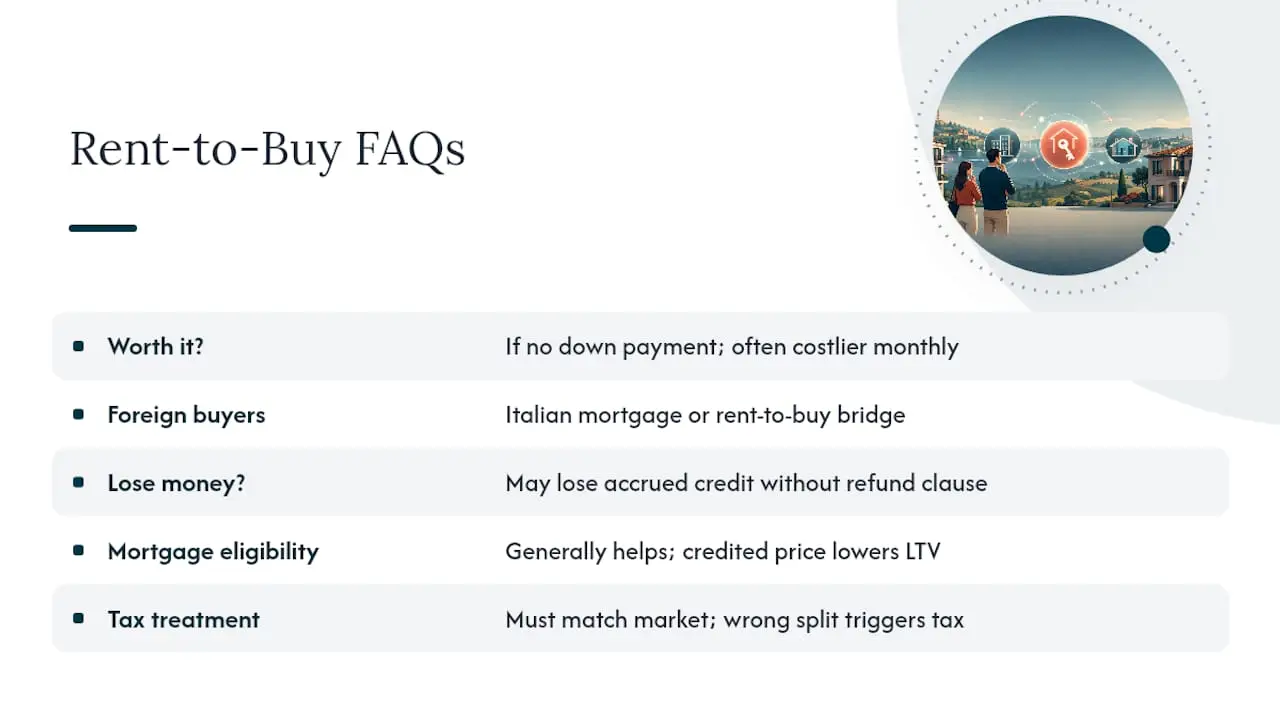
Is rent-to-own worth it in Italy compared with a mortgage?
It depends on your liquidity. Rent-to-buy is worth considering if you lack a down payment now, since it locks the price and builds a documented payment history, but it typically costs more monthly than a mortgage would.
What are the best financing options for foreign buyers in Italy?
Most foreign buyers either arrange a mortgage through an Italian bank with sufficient income documentation or use rent-to-buy as a bridge while they build creditworthiness or gather savings for a future mortgage.
Can I lose money if I don’t exercise my rent-to-buy option?
You risk losing part or all of the accumulated price credit if the contract doesn’t specify clear refund terms. Always confirm this clause with a notary before signing.
Does rent-to-buy affect my eligibility for a mortgage later?
Generally it helps. The accumulated price credit functions like a down payment, lowering the loan-to-value ratio a bank calculates, which can improve both approval odds and the rate offered.
What tax treatment applies to rent-to-buy contracts in Italy?
The Agenzia delle Entrate requires the usage and price components to be market-aligned; incorrect splits risk reclassification as an installment sale with heavier immediate tax consequences.
This article is general information, not a substitute for advice from a qualified financial advisor. Consult a qualified financial professional about your own circumstances before acting on anything here.
Sources
- Il rent to buy (Consiglio Nazionale del Notariato guide)
- Il Rent to Buy come leva finanziaria per l’acquisto immobiliare · ADICU
- Rent to Buy vs mutuo nel 2025: confronto numerico (OkCasaWeb)
- Italy: how rent-to-buy works for foreigners (Investropa)