
Condominium rules in Italy are a mix of statutory provisions in the Civil Code and building-specific bylaws that together govern ownership shares, common-area use, and how costs get split among owners. If you’re buying, the first move is simple: ask the seller or agent for the bylaws, the last two years of assembly minutes, and the current accounts before you sign anything.
TL;DR:
- Buyers should verify the ownership shares, recent meeting minutes, and the building’s arrears report to assess financial health and avoid liabilities.
- The millesimi table must match the unit’s actual size to ensure correct expense sharing and voting power, especially in buildings with complex cost formulas.
- Understanding contractual versus assembly regulations is crucial, as some restrictions, like rental caps, may be enforceable or invalid in court.
- It is essential to confirm proper municipal permits for work, regional rules on heating and rentals, and ensure bylaws are enforceable before closing.
- Working with an English-speaking notary can help perform comprehensive due diligence remotely, covering legal checks, document review, and escrow arrangements.
Table of Contents
- What Are Condominium Rules in Italy, and Why Do They Matter to Buyers?
- Legal Basis: The Civil Code and the 2012 Reform
- Who Runs the Condominio: Assembly, Administrator, and the Notary’s Role
- How Condominium Fees Are Split: Millesimi, Ordinary Costs, and Legal Exceptions
- Assembly Meetings, Voting Majorities, and Proxies
- Common Restrictions and Disputes: Pets, Noise, and Short-Term Rentals
- Due Diligence Checklist: What Buyers Must Request Before Signing
- How Condominium Rules Apply Locally Across Italy
- What We See Go Wrong in Foreign Purchases, and How to Avoid It
- How Notaryinitaly Makes Condominium Due Diligence Straightforward
- Where to Verify These Rules Yourself
- Sources
What Are Condominium Rules in Italy, and Why Do They Matter to Buyers?
Every multi-unit building in Italy with more than two owners operates as a condominio, a legal structure governed primarily by the Civil Code and reinforced by building-specific regulations. These rules decide who pays for the new roof, who can rent out a unit short-term, and who gets a vote when the elevator needs replacing.
For a foreign buyer, condominium rules in Italy are not background paperwork. They shape recurring costs, restrict how you can use your own unit, and determine whether a past dispute follows the property into your ownership. Skipping this review is one of the most common and costly mistakes international purchasers make, and it’s entirely avoidable with the right documents in hand before closing.
Legal Basis: The Civil Code and the 2012 Reform
Articles 1118 through 1139 of the Italian Civil Code form the backbone of condominium law, covering everything from how common areas are defined to how assemblies must be convened and how expenses get divided. The 2012 reform updated much of this framework, tightening rules on administrator appointments, financial transparency, and meeting procedures, and it remains the operative standard for buildings across the country.
Condominium regulation comes in two distinct forms, and the difference matters more than most buyers realize:
- Contractual regulation, embedded directly in the original sale deeds by the developer, can impose restrictions that go beyond the Civil Code, such as limits on renting out units or running a business from a ground-floor space.
- Assembly regulation, adopted later by a vote of owners, generally cannot restrict individual property rights the same way; it mainly governs day-to-day building management like quiet hours or shared-space use.
Certain protections are non-derogable no matter which type applies. Owners cannot be stripped of their proportional rights to common parts like the roof, stairwells, or building facade. Bylaws can restrict how you use your unit, but they cannot dissolve your ownership stake in what the building shares collectively.
Who Runs the Condominio: Assembly, Administrator, and the Notary’s Role
The assembly of owners is the decision-making body, and every vote carries dual weight: one measured by the number of owners present, and one measured by their millesimi, the proportional share tied to unit size and value. A resolution typically needs both thresholds satisfied to pass.
Buildings with more than eight units are legally required to appoint an administrator, whose duties include:
- Managing the condominium’s dedicated bank account and executing assembly resolutions.
- Preparing and presenting annual accounts (the consuntivo and preventivo) for owner approval.
- Representing the building in legal disputes involving common areas.
- Maintaining mandatory insurance coverage and handling the transition when a new administrator takes over.
Before closing, a notary in Italy performs preventive legality checks, confirming clear title, verifying encumbrances, and checking whether the bylaws are enforceable against a new owner. This preventive review, combined with the notary’s institutional anti-money-laundering function, is what catches problems before they become your problems.
Pro Tip: Ask the administrator directly for a “certificato di regolarità dei pagamenti” — a certified statement of arrears status. Sellers sometimes omit this voluntarily, but it’s your clearest window into whether the unit carries hidden debt.
How Condominium Fees Are Split: Millesimi, Ordinary Costs, and Legal Exceptions
Every unit in an Italian condominio is assigned a millesimi value, a proportional share (out of 1,000 total) based on size, position, and use. This figure determines both your voting weight in the assembly and your share of most expenses, and it’s one of the first things you should verify against the official tabella millesimale.
Typical ordinary items include:
- Cleaning and lighting of common areas
- Building insurance premiums
- Routine elevator maintenance and administrator fees
- Heating costs where a centralized system is in place
Extraordinary expenses cover larger, less frequent interventions, roof repairs, facade restoration, structural work, and these often require a qualified majority vote before they can be authorized and billed.
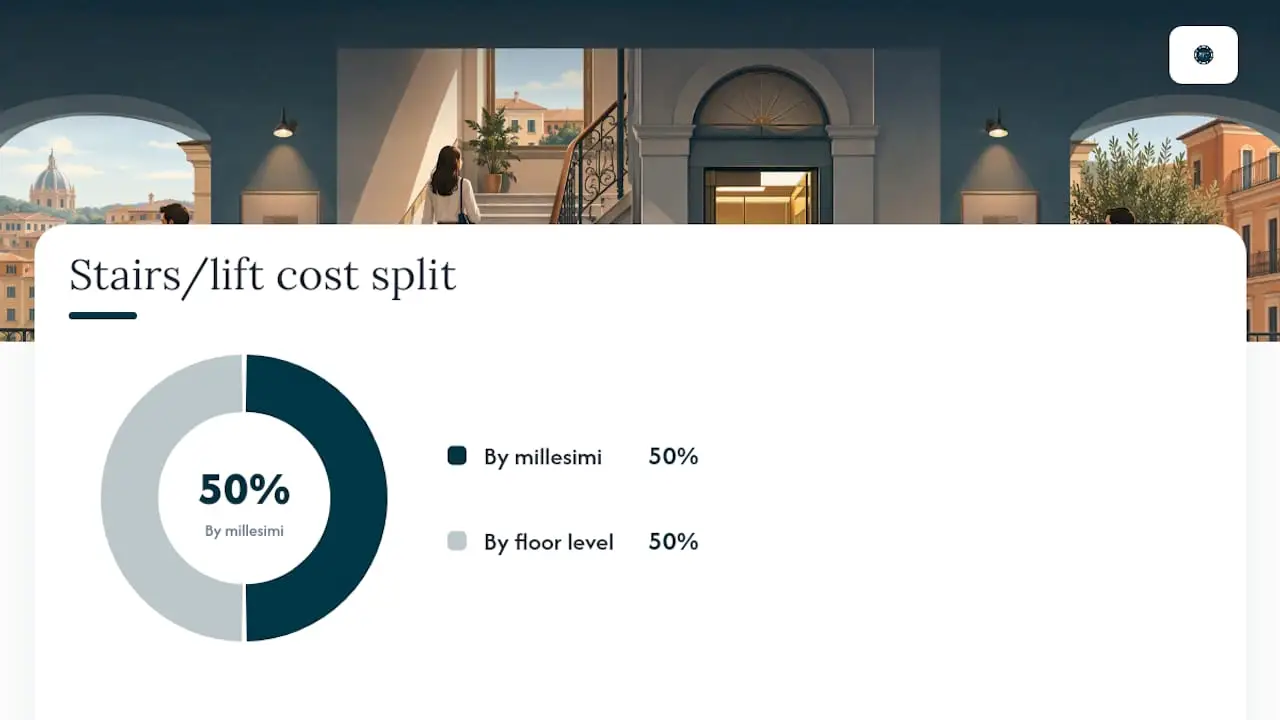
Article 1124 of the Civil Code sets a distinct formula for stairs and elevators: half the cost is split by millesimi, and the other half by floor level, since owners on higher floors benefit more from a working lift. Article 1123 goes further, requiring that when a shared facility serves owners unequally, such as a heating riser or a lift that some ground-floor units never use, costs must follow actual use rather than a flat millesimi split.
Heating is worth flagging on its own. In buildings with centralized systems, heating and radiator valve costs tend to be the single largest variable in a unit’s annual fees, and asking for a seasonal preventivo before you buy can save you from an unpleasant winter surprise.
Arrears carry real consequences. An administrator can obtain a court injunction (decreto ingiuntivo) against a delinquent owner without needing separate assembly authorization, and in some cases services to a unit can be suspended. When a property changes hands, buyer and seller can share joint liability for the current and prior year’s unpaid ordinary charges, which is exactly why an arrears check before closing isn’t optional.
Assembly Meetings, Voting Majorities, and Proxies
Getting a resolution passed in an Italian condominio follows a defined procedure, and understanding the sequence helps you know what to expect if you’re already an owner or about to become one.
- Notice and agenda. The administrator must send written notice at least five days before an ordinary meeting, listing every agenda item and attaching relevant documents like budgets or repair quotes.
- First call quorum. Passing most ordinary resolutions on first call requires a majority of attendees representing at least half the building’s total millesimi.
- Second call quorum. If the first call fails to reach quorum, a second meeting can proceed with a lower threshold, though certain extraordinary matters (like major structural work) still demand higher qualified majorities regardless of which call is used.
- Proxies and remote participation. Owners who cannot attend in person may appoint a proxy, and many buildings now permit video conferencing for meetings, a practice that has become increasingly common and useful for absentee foreign owners.
- Minutes. Every resolution must be recorded with the exact vote count in both heads and millesimi, creating the paper trail you’ll want to review during due diligence.
Common Restrictions and Disputes: Pets, Noise, and Short-Term Rentals
Not every rule written into a building’s bylaws will hold up in court, and the distinction matters if you’re weighing whether a restriction actually limits you.
- Pets: A blanket ban on pets in a purely assembly-adopted regulation is generally unenforceable; courts have consistently sided with owners unless the restriction is tied to genuine nuisance and was written into the original contractual bylaws.
- Quiet hours and everyday conduct: Rules on noise, waste sorting, and shared-space etiquette are common and enforceable parts of daily condominium life, and worth reading closely before you move in.
- Short-term rentals: Contractual bylaws can restrict tourist rentals, but even where they don’t, municipal registration rules apply independently, so check both layers before listing a unit on a rental platform.
- Dispute resolution: Italian law requires mandatory mediation attempts before most condominium disputes can reach court, though a formal notice to the administrator or a fresh assembly vote often resolves smaller conflicts faster.
Due Diligence Checklist: What Buyers Must Request Before Signing
A property that looks flawless on a viewing can still carry building-level liabilities that transfer with the deed. The only way to catch them is to request the right paperwork early, ideally before you make a binding offer.
- Bylaws (specify whether contractual or assembly, since enforceability differs).
- Millesimi table, cross-checked against the unit’s actual size and floor.
- Minutes from the last 24 to 36 months, revealing pending disputes or planned works.
- Budgets, both the consuntivo (actual spending) and preventivo (projected spending).
- Reserve fund balance, showing whether the building has saved for upcoming repairs.
- Arrears aging report, listing which units, if any, owe money and for how long.
- Planned extraordinary works with technical reports and cost quotes attached.
- Insurance policies covering the building’s common areas.
- Litigation records, confirming whether the condominio is party to any active lawsuits.
| Buyer requirement | Document to request | Why it matters |
|---|---|---|
| Confirm cost share | Millesimi table | Sets your voting weight and expense allocation |
| Check for hidden debt | Arrears aging report | Reveals joint liability risk at closing |
| Understand restrictions | Bylaws (contractual/assembly) | Determines what you can and cannot do with your unit |
| Anticipate future costs | Planned works + technical reports | Flags major extraordinary expenses coming due |
| Verify governance history | Last 24–36 months of minutes | Shows disputes, resolutions, and administrator conduct |
Watch for red flags: significant arrears across multiple units, major extraordinary works planned without a funded reserve, a millesimi table that doesn’t match the unit’s actual size, or contractual restrictions that quietly limit rental income. If any of these surface, ask for seller warranties, consider an escrow arrangement to cover outstanding liabilities, or simply delay signing until the picture is clear. A notary can help structure deed clauses that protect you against exactly this kind of post-purchase surprise, drawing on the step-by-step legal process foreign buyers should expect at every stage.
How Condominium Rules Apply Locally Across Italy
The Civil Code sets the national floor for condominium governance, but a meaningful layer of practical variation happens at the municipal level, and foreign buyers often miss it entirely.
Short-term rental registration, waste disposal schedules, and the official heating season (typically running from mid-October to mid-April in northern regions, shorter in the south) are set by local ordinance, not the Civil Code. Before finalizing a purchase, confirm that any past renovation work carries the proper CILA or SCIA filing with the local municipality; unpermitted work can create liability that outlives the seller. Ask the administrator directly whether the building’s heating system runs centrally and how termovalvole (radiator valves) factor into billing, since this varies widely by region and building age. For anything ambiguous, a local notary can confirm municipal compliance alongside the administrator before you commit.
What We See Go Wrong in Foreign Purchases, and How to Avoid It
Across cross-border transactions, the same oversights surface again and again: buyers skip the minutes entirely, underestimate how thin a reserve fund really is, or accept a millesimi figure without checking it against the unit’s actual footprint. None of these is hard to catch. They’re just easy to skip when you’re juggling a foreign legal system, a language barrier, and a compressed timeline.
The fix is procedural, not complicated. Request a certified arrears statement before you negotiate price. Use escrow to hold funds against any unresolved building liability rather than trusting a verbal assurance. And work with an English-speaking notary who can walk you through exactly what the deed obligates you to, in terms you actually understand, rather than translating legal Italian on the fly during a signing you don’t fully follow.
— Living
How Notaryinitaly Makes Condominium Due Diligence Straightforward
Notaryinitaly is the alternative to piecing together a cross-border purchase through translated documents and secondhand advice. Because the firm works entirely in English and structures closings for clients who aren’t physically in Italy, you get the same preventive legality checks a local buyer would expect, without the language gap or the need to fly in for signing day.

That means verifying bylaws and arrears before you commit, drafting deed language that reflects what you actually agreed to, and coordinating escrow when a building carries unresolved liabilities. Notaryinitaly also handles remote signings for foreign buyers who cannot travel, and offers property purchase due diligence that covers exactly the checklist outlined above, bylaws, millesimi, minutes, arrears, and planned works, before you sign anything binding.
If you’re evaluating a condominium purchase in Italy and want someone to review the building’s paperwork before you commit, reach out to ngcerini@notaryinitaly.com for a consultation on your specific case, or explore notary duties for property purchases to see what the process involves from start to finish.

Where to Verify These Rules Yourself
For primary confirmation of anything covered here, the Notariato offers official guidance on notarial functions and buyer protections, while Immobiliare.it’s condominium guide covers the everyday rules, quiet hours, waste sorting, and building etiquette, that shape daily life once you’ve moved in.
This article is general information, not a substitute for advice from a qualified lawyer. Consult a qualified legal professional about your own circumstances before acting on anything here.
Sources
- Who is the Notary? | Notariato
- Spese Condominiali: Who Pays What in an Italian Condominio | Recording Law
- Immobiliare
Recommended
- 7 Top Mistakes Foreign Buyers Make
- Best Italian Property Due Diligence Checks
- Buying Property in Italy as a Foreigner: Step-by-Step Legal Guide
- Italy Property Closing Process for Foreigners
The information provided here is general in nature and does not replace professional assistance. Reading this content does not create a professional-client relationship.