
You can form a compliant Italian company for roughly €300 to €6,000 in formation fees alone, excluding share capital. Most small foreign founders end up choosing between an SRLS (simplified limited liability company) or a standard SRL, with the decision driven largely by capital requirements, notary involvement, and how quickly they need to launch. The top cost drivers are consistent across cases: notary fees, mandatory government taxes, and the share capital deposit itself.
TL;DR:
- Choosing between an SRLS and a standard SRL largely depends on your need for customization and notary fees, with SRLS typically skipping bespoke bylaws and notary costs.
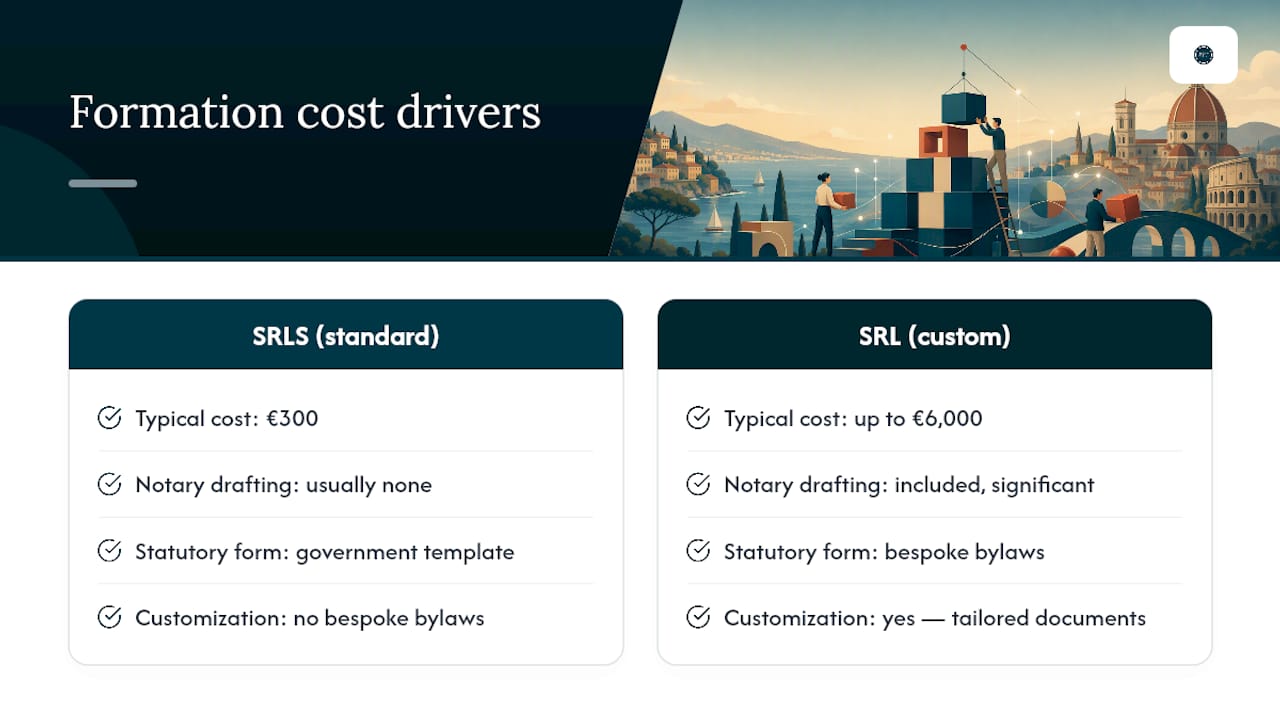
- Formation costs vary from around €300 for an SRLS with the standard template to €6,000 for a fully bespoke SRL, excluding share capital, which generally starts at €1 to €10,000.
- Notary fees are the primary variable cost, with SRLS often requiring no notary fee, while an SRL can cost between €1,500 and €6,000, depending on province and complexity.
- Opening an Italian company requires deposit of share capital, obtaining a codice fiscale, and signing before a notary, a process that typically takes 3 to 8 weeks based on circumstances.
- Remote legal support, especially for non-residents, can facilitate Italian company formation in English, with services that include notarization, escrow, and document translation to prevent delays.
Table of Contents
- Company Formation Cost Italy: What Drives the Number Up or Down
- Company Types in Italy and Who They Actually Suit
- What Formation Actually Costs, Line by Line
- How to Form a Company in Italy: The Step-by-Step Checklist
- Why the Notary’s Role Is Not Just a Formality
- How Long Formation Really Takes and What Slows It Down
- How Company Formation Rules Apply Across Italy
- What Actually Matters When You Budget for This
- Cerini Notary Office: Formation Without the Language Barrier
- Sources
- FAQ
Company Formation Cost Italy: What Drives the Number Up or Down
The gap between €300 and €6,000 is not random. It reflects which legal structure you pick, whether you use the standard statutory template or a customized one, and how much professional guidance you bring in before signing anything. An SRLS formed under the standard model typically skips notary drafting fees entirely, because the deed follows a fixed government template. A standard SRL, by contrast, involves a notary drafting bespoke bylaws, which contributes significantly to the formation fees.
Understanding which structure fits your situation is the real starting point, not the fee schedule itself.
Company Types in Italy and Who They Actually Suit
Italy offers a handful of legal structures, and picking the wrong one often costs more in the long run than any formation fee.
- Sole proprietorship (ditta individuale): Best for solo freelancers or consultants with no liability shield needed. Cheapest to open, but you are personally liable for business debts.
- SRLS (simplified limited liability company): Designed for small ventures and first-time founders. Share capital can range from €1 to €9,999.99, and the statutory template keeps notary costs low since bylaws cannot be customized.
- SRL (standard limited liability company): The most common choice for foreign SMEs with multiple shareholders or specific governance needs. You can technically start with €1 in capital, but if capital sits under €10,000, Italian law requires you to set aside 20% of annual profits into a legal reserve until you reach that threshold. Most serious investors capitalize at €10,000 to avoid the reserve requirement altogether.
- SpA (joint stock company): Requires €50,000 minimum share capital and suits larger operations, public fundraising ambitions, or companies planning to list shares. Rarely the right first move for a small foreign-owned venture.
- Branch or subsidiary of a foreign company: Sometimes preferable when a parent company wants a direct Italian presence without incorporating a wholly new entity. A branch avoids creating a separate legal person but still requires registration with the Italian Business Register and carries its own compliance obligations.
For most non-Italian entrepreneurs testing the market or running a lean operation, the SRLS or standard SRL will be the answer. The branch route makes more sense for established multinationals extending an existing structure into Italy rather than launching something new.
What Formation Actually Costs, Line by Line
Company formation expenses in Italy split cleanly into one-off setup costs and recurring first-year obligations. Here is how the numbers typically break down.
| Cost item | SRLS (simplified) | Standard SRL | Notes |
|---|---|---|---|
| Notary fees | Usually none (standard template) | €1,500–€6,000 (formation only, excluding capital) | SRL fees vary by province and bylaw complexity |
| Government concession fee | Fixed statutory amount | Fixed statutory amount | Applies to both structures |
| Registration tax | €200 | €200 | Paid to Agenzia delle Entrate at incorporation |
| Stamp duty | Included in filing | Included in filing | Charged on the deed itself |
| Chamber of Commerce fees (diritti di segreteria) | Modest, fixed schedule | Modest, fixed schedule | Set by the local Chamber, varies slightly by province |
| PEC (certified email) | €5–€30/year | €5–€30/year | Legally required for every Italian company |
| Digital signature | €20–€50 | €20–€50 | Needed to sign filings electronically |
| Initial accountant onboarding | Often skipped or minimal | Roughly €800 | Recommended even when not strictly mandatory |
| Share capital deposit | €1 to €9,999.99 | Commonly €10,000 (25% due at signing, or €2,500) | Held in a notary or bank escrow account until registration |
A realistic first-month budget for a standard SRL looks something like notary and taxes around €2,500, accountant setup near €800, and a 25% capital deposit of roughly €2,500, landing near €6,000 total before any operational spending begins. The mandatory items (notary, government fees, registration tax) are non-negotiable. The accountant and any pre-formation legal consultation are professional add-ons, but skipping them tends to cost more later in filing errors or bylaw mismatches.
How to Form a Company in Italy: The Step-by-Step Checklist
The formation sequence is fairly linear, but the details shift depending on whether you are an EU resident, a non-EU founder, or someone using a power of attorney from abroad.
- Choose your structure and draft (or select) your bylaws. SRLS founders use the fixed statutory template; SRL founders work with a notary to customize governance terms.
- Gather founder documents. Passport copies, proof of address, and, for non-EU founders, documents that are often apostilled and translated into Italian before the notary will accept them.
- Obtain a codice fiscale (Italian tax code) for each shareholder and director, which the Agenzia delle Entrate or an Italian consulate abroad can issue.
- Deposit share capital. Funds typically move into a notary-held escrow account rather than a standard bank account, which sidesteps the common bottleneck of opening an Italian business bank account before incorporation is complete.
- Sign the deed of incorporation before a notary. This step cannot be delegated or skipped; it is the legal act that creates the company.
- File with the Registro delle Imprese at the local Chamber of Commerce using the Single Business Communication e-procedure, which also triggers VAT and tax registration with the Agenzia delle Entrate.
- Consider the online SRL route. Under D.Lgs. n. 183/2021, which implements EU Directive 2019/1151, founders can complete the entire process online under notary supervision when the company is seated in Italy and capital contributions are in cash. Non-EU founders using a power of attorney generally still need the traditional in-person or remote notarial deed rather than the fully digital track.
- Set up your PEC address and digital signature, both required before you can file anything electronically.
Why the Notary’s Role Is Not Just a Formality
Every SRL, SRLS, and SpA in Italy requires a public deed signed before a notary. This is not bureaucratic friction, it is a substantive legal check. The Consiglio Nazionale del Notariato confirms that the notary verifies the legality of the incorporation act and, for standard SRLs, helps tailor bylaws to a founder’s actual long-term objectives rather than a generic template.
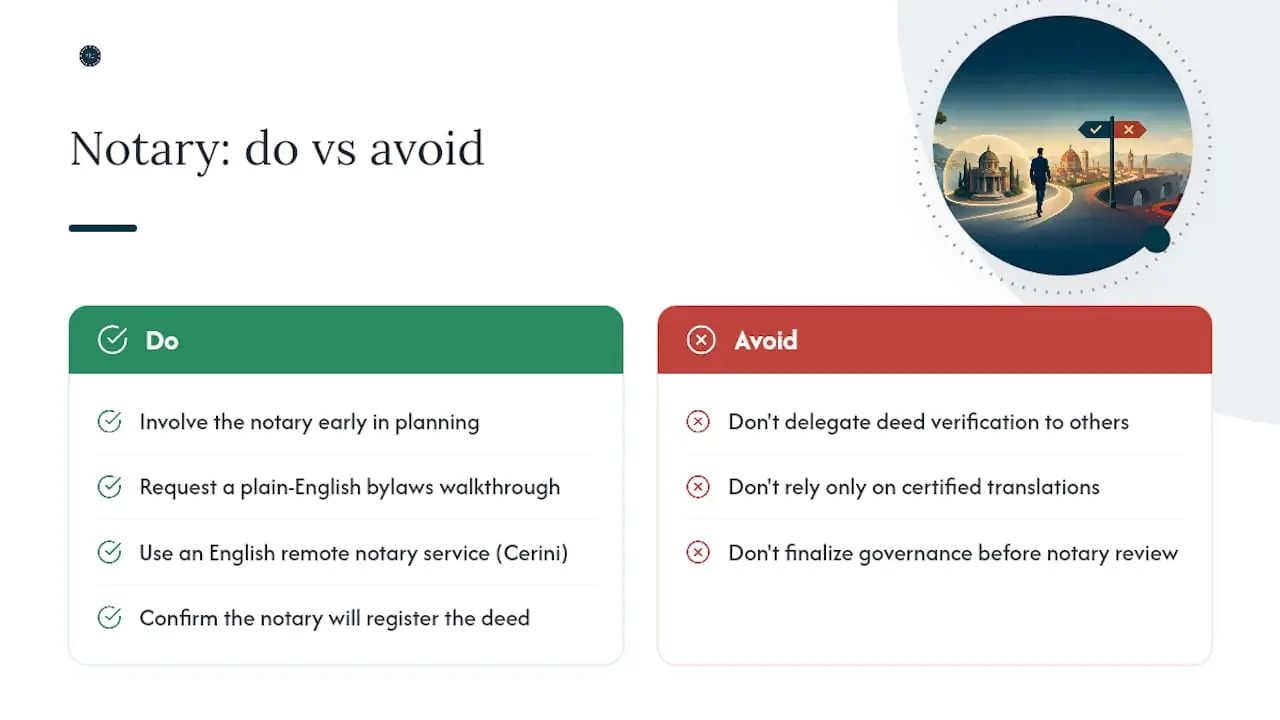
That verification step cannot be delegated to an accountant, a lawyer, or an online formation service. The notary is the only party legally empowered to authenticate the deed and register it correctly. Founders who bring in notarial guidance early, before finalizing governance terms or shareholder agreements, tend to avoid costly restructuring later when a bylaw clause turns out to conflict with how the company actually operates.
For a founder based in New York, London, or Singapore, this creates a practical problem: most Italian notaries operate exclusively in Italian and expect in-person signings. Cerini Notary Office works differently, offering full English-speaking support and remote services that let foreign founders complete notarial acts without booking a flight or hiring a translator for every document exchange.
Pro Tip: Ask your notary to walk through your bylaws in plain English before signing, even if a certified translation exists. Legal nuance gets lost in translation more often than founders expect, and catching a misaligned clause before the deed is signed is far cheaper than amending it afterward.
How Long Formation Really Takes and What Slows It Down
Timelines vary more than most founders expect, largely because of factors outside the notary’s control.
- SRLS formation: Typically 3 to 6 weeks from document collection to Business Register filing.
- Standard SRL, online route: Usually 4 to 8 weeks when using the D.Lgs. n. 183/2021 digital procedure.
- Non-EU founders using power of attorney: Often longer, since opening an Italian business bank account as a non-resident remains one of the most common bottlenecks in the entire process.
Recurring first-year costs add up beyond the initial formation fee. Budget for ongoing commercialista (accountant) fees, annual PEC renewal, digital signature renewal, and an SDI-compliant e-invoicing platform, since Italy requires electronic invoicing for nearly all business transactions. Province-level fee variation is real: notary rates and Chamber of Commerce fees in Milan tend to run higher than in smaller provinces, so a founder quoted a fee in Rome or Naples may see a different number from a Milan-based notary for comparable work.
The most common delays trace back to three things: apostille and translation turnaround for non-EU documents, scheduling conflicts with notaries during peak periods, and bank account approval for non-resident directors. Booking your notary appointment early and preparing translated documents before you need them avoids most of the wait.
How Company Formation Rules Apply Across Italy
Italian company law is national, set by the Codice Civile and enforced consistently through the Agenzia delle Entrate and the Registro delle Imprese network. But execution has local texture. Every company registers with the Registro delle Imprese at its local Chamber of Commerce, and separately obtains VAT and tax registration through the Agenzia delle Entrate, regardless of whether the company is based in Milan, Turin, or a smaller southern province.
What does vary locally are the diritti di segreteria (Chamber secretary fees) and typical notary rates, both of which run higher in major commercial hubs like Milan than in smaller provinces. The online SRL procedure under D.Lgs. n. 183/2021 applies uniformly nationwide, since it is a national digital infrastructure rather than a province-specific service. Founders comparing quotes from notaries in different regions should expect the legal requirements to be identical, even when the invoice is not.
What Actually Matters When You Budget for This
Most guidance on Italian company formation treats the notary as a line-item expense to minimize. That framing gets the priority backward. The fee difference between a bare-bones SRLS and a properly structured SRL with customized bylaws is often a few thousand euros, but the cost of unwinding a poorly drafted governance clause, or discovering a shareholder agreement doesn’t hold up, dwarfs that gap.
The conventional advice tells foreign founders to shop for the cheapest formation service. The better question is whether that service, or notary, can actually communicate with you clearly enough to catch problems before they’re baked into a signed deed. Language friction is not a minor inconvenience in this process, it’s where expensive mistakes originate.
If you’re weighing SRLS against standard SRL, prioritize this: figure out your capital needs and investor structure first, then let that decision drive the entity choice. Don’t pick SRLS purely for the lower upfront cost if you know you’ll need to restructure for outside investment within a year. Formation cost is a one-time number. A bad structural choice compounds.
— team
Cerini Notary Office: Formation Without the Language Barrier
There is an alternative to piecing together a formation team from unfamiliar local providers, a notary, a translator, an accountant, which helps ensure better coordination. A notary office provides services including company incorporation, remote power of attorney arrangements, and escrow account setup for share capital deposits, all in English, whether clients are local or remote.

This matters most for non-resident founders who cannot easily travel to Italy for signings, for cross-border shareholder groups needing bylaws that account for multiple jurisdictions, and for anyone whose company structure is complex enough that a generic template deed won’t cut it. Document legalization and translation services are available to address common formation bottlenecks for founders outside the EU.
If you’re planning a company formation and want a clear cost estimate for your specific situation, whether that’s an SRL with foreign shareholders, a remote SRLS setup, or a structure involving escrow for capital contributions, reach out directly. Explore company incorporation services or email ngcerini@notaryinitaly.com to discuss your case and get a fee quote tailored to your structure.
Sources
For primary confirmation of formation rules and fees, consult the Consiglio Nazionale del Notariato on notarial procedures, the Agenzia delle Entrate for tax and VAT registration, and your local Chamber of Commerce for province-specific Registro delle Imprese fees. For remote formation guidance, see how to set up an Italian SRL remotely.
This article is general information, not a substitute for advice from a qualified financial advisor. Consult a qualified financial professional about your own circumstances before acting on anything here.
- Società a responsabilità limitata semplificata – Consiglio Nazionale del Notariato
- Incorporation and registration of a company – Agenzia delle Entrate
FAQ
How much does it cost to set up a company in Italy?
Formation fees alone typically run from a few hundred euros for an SRLS using the standard template up to €1,500–€6,000 for a standard SRL, excluding share capital. Share capital itself adds anywhere from €1 to €10,000 or more depending on the structure you choose.
How much money do you need to start a business in Italy?
Beyond formation fees, plan for share capital (as low as €1 for SRLS, commonly €10,000 for standard SRL), plus first-year running costs like accountant fees, PEC, and digital signature renewals. A realistic first-month total for a standard SRL, including notary, taxes, and a partial capital deposit, lands around €6,000.
How do you set up a company in Italy as a foreigner?
You choose a legal structure, gather apostilled and translated documents, obtain a codice fiscale, deposit share capital into a notary-held account, and sign the incorporation deed before a notary. From there, registration with the Registro delle Imprese triggers your VAT and tax numbers.
What’s the difference between SRLS and standard SRL costs?
SRLS uses a fixed statutory template, which usually eliminates notary drafting fees and caps capital between €1 and €9,999.99. Standard SRL allows customized bylaws but involves notary fees typically between €1,500 and €6,000, plus a common capital target of €10,000 to avoid legal reserve requirements.
Is 3,000 euros a good salary in Italy?
This depends heavily on the region and cost of living rather than company formation specifics. Salaries vary significantly across Italy, generally stretching further in smaller provinces than in Milan.
Can Cerini Notary Office help with remote company formation?
Yes. Cerini Notary Office provides full English-speaking support and remote notarial services, including company incorporation and escrow handling for share capital, designed specifically for founders who cannot easily travel to Italy for signings.
Recommended
- Notary Requirements to Start a Company in Italy
- Italian Company Formation Foreign Shareholders
- Italian Company Formation for Foreign Investors
- How to Open a Company in Italy as a Foreigner
The information provided here is general in nature and does not replace professional assistance. Reading this content does not create a professional-client relationship.