
Cadastral categories are the fiscal labels Italy’s Agenzia delle Entrate assigns to every registered building, and that label sets the property’s cadastral income, the figure used to calculate IMU and other taxes. Check the visura catastale before signing anything, confirm the listed owner matches the deed, and bring in a notary the moment the two records disagree.
TL;DR:
- The cadastral income used for tax calculations can vary significantly between categories and classes, influencing IMU and transfer taxes.
- A property’s category and class must be accurately checked via a visura catastale, especially before making an offer or transaction, to avoid unexpected tax or legal issues.
- Changing a property’s cadastral category requires a formal Docfa filing by licensed professionals and does not substitute municipal planning permits.
- Errors such as outdated records, mismatched ownership, or undocumented use changes are common and can affect resale, financing, and future upgrades.
- Buyers should verify that the cadastral data matches actual use and legal paperwork, and involve a notary early to avoid discrepancies during closing.
Table of Contents
- What Are Cadastral Categories in Italy?
- How Does Cadastral Income Affect Your Taxes?
- How Do You Get a Visura Catastale in Italy?
- How Do You Change a Property’s Cadastral Category?
- Why Do Some Italian Regions Handle Land Records Differently?
- What Should Buyers Check Before Closing?
- Where Do Italy’s Cadastral Categories Come From?
- What Can and Cannot Be Done Under Each Category?
- How Does Category Affect a Property’s Sale Value?
- What Are the Most Common Cadastral Data Errors?
- Who Updates Cadastral Records Besides Docfa?
- How Do Cadastral Categories Interact with Zoning Rules?
- An Author’s Perspective on Cadastral Due Diligence
- How Notaryinitaly Verifies Your Property Before You Sign
- Sources
What Are Cadastral Categories in Italy?
Every building in the national cadastre falls into one of six groups, each covering a different use. The official quadro generale delle categorie published by the Agenzia delle Entrate lists dozens of subcategories, but a handful appear on almost every visura you will encounter.
- Group A — dwellings, offices, and similar civil-use spaces
- Group B — collective-use buildings such as schools, hospitals, and libraries
- Group C — commercial and ancillary units like shops, garages, and warehouses
- Group D — special-purpose buildings including hotels, factories, and banks
- Group E — buildings with particular characteristics, such as stations or lighthouses, often public
- Group F — fictitious or non-productive entities, used for units under construction or common areas
- Land (terreni) — agricultural and unbuilt parcels, tracked in a separate cadastral archive
Within Group A, you will most often see A/1 (upscale residences), A/2 (standard housing), and A/10 (offices). Group C brings C/1 (retail shops) and C/2 (storage). Group D includes D/2 for hotels, while E/1 covers stations and similar public infrastructure, and F/1 marks common areas in a condominium.
Each subcategory also carries a class, a number reflecting relative fiscal capacity within that subcategory. Two apartments coded A/2 in the same building can sit in different classes if one has better finishes or a larger surface, and that class difference changes the cadastral income each one generates.
How Does Cadastral Income Affect Your Taxes?
Rendita catastale, or cadastral income, is the taxable value the state assigns to a property based on its category, class, and size. It is not the market price and it is almost always lower, but it is the number tax authorities actually use to calculate what you owe.
Several taxes run directly off this figure:
- IMU (the municipal property tax) applies a multiplier to the revalued cadastral income to set the annual bill
- Registration tax on certain purchases and other transfer taxes use cadastral value as their base, particularly for private-party sales where the “prezzo valore” mechanism applies
- Benefits and exemptions, such as reduced rates for a primary residence, depend on the category code, since categories A/1, A/8, and A/9 are excluded from most first-home concessions regardless of how the buyer actually uses the unit
A category change can shift the tax outcome meaningfully. An attic reclassified from unusable storage (Group F) to a livable A/2 unit gains habitability, and gains a cadastral income that did not exist before, which then feeds into IMU calculations going forward. The Agenzia delle Entrate’s category framework makes clear that the category code, not the property’s physical condition alone, drives which tax rules apply.
Pro Tip: Before making an offer, ask the seller for the cadastral income figure directly rather than estimating it from the category alone. Class differences within the same category can produce meaningfully different tax bases.
How Do You Get a Visura Catastale in Italy?
Getting an official cadastral extract is straightforward once you have the right digital credentials. Here is the process:
- Access the Agenzia delle Entrate’s online portal using SPID, CIE (electronic ID card), or CNS (national services card). The cadastral services page covers the national territory, with the notable exception of the autonomous provinces of Trento and Bolzano, which run separate systems.
- Choose the right document type. A visura by subject shows every property tied to a tax code; a visura by immobile targets one specific unit; a planimetria gives the floor plan on file; an ispezione ipotecaria checks for mortgages and liens.
- Read the four fields that matter most: category and class, rendita catastale, and intestatario (the registered holder). Cross-check the intestatario name against the deed (atto di provenienza) before relying on either document alone.
- Check the filing history for recent Docfa submissions, which signal a change of use, a renovation, or a category update that may not yet be reflected in older listings.
Businesses and professionals handling volume requests typically use Sister, the enterprise-facing platform that returns visure in both PDF and XML under a paid convention, rather than the personal consultation service designed for individual taxpayers.
How Do You Change a Property’s Cadastral Category?
Reclassifying a unit, whether converting a storage space into livable square footage or turning a shop into an office, is a formal administrative act, not a simple form update.
- A Docfa filing is required whenever the physical characteristics or the actual use of a unit change enough to affect its category, class, or cadastral income.
- Docfa is the official software professionals use to submit these updates, and only a licensed technical professional, typically a surveyor, architect, or engineer, can prepare and file it.
- The current Docfa 4.00.5 compatibility tables specify which destination-of-use codes are compatible with which categories, particularly for Groups D and E.
- A cadastral update is separate from municipal planning approval. Filing a Docfa does not substitute for the building permit or change-of-use authorization the municipality must grant first; the two processes run on parallel tracks with different authorities.
Why Do Some Italian Regions Handle Land Records Differently?
Most of Italy runs on the transcription-based cadastre, where the fiscal record and the deed archive are related but administratively distinct systems. A smaller set of territories, principally the autonomous provinces of Trento and Bolzano and a number of municipalities in neighboring areas, use the Tavolare system instead, a title-registration model closer to systems used in parts of central Europe.
- The cadastre itself is a fiscal inventory; it exists to assess taxes, not to prove ownership.
- The Conservatoria records deed transcriptions, and it is that archive, not the visura, that establishes legal title.
- In Tavolare areas, ownership works differently again, so buyers there should request both the fiscal cadastre extract and the local title-register documents before relying on either alone.
What Should Buyers Check Before Closing?
International investors run into trouble less often because of a bad category and more often because nobody checked whether the paperwork matches reality. A pre-offer and pre-closing review should always include a documented paper trail.
Documents to request:
- Current visura catastale and planimetria
- Atto di provenienza (the deed showing how the current owner acquired the property)
- Certificato di agibilità where the property’s habitability is relevant
- Evidence of any Docfa filings from the past several years
Verification steps:
- Compare the intestatario on the visura against the seller named in the deed
- Check whether the category or class changed recently, and why
- Walk the unit against the planimetria on file rather than trusting the listing description
- Look for ipoteche (mortgages) or annotations that could follow the property after the sale
| Red flag | Why it matters |
|---|---|
| Missing or outdated planimetria | The floor plan on file may not match the actual layout, which can block a future sale or renovation |
| Intestatario does not match the deed | Suggests an unrecorded transfer or inheritance issue that needs resolution before closing |
| Undocumented change of use | A converted space without a Docfa filing carries unresolved tax and legal exposure |
| Anomalies in Tavolare-area records | The title system differs from the rest of Italy and needs local expertise to interpret correctly |
Where Do Italy’s Cadastral Categories Come From?
The modern Italian cadastre traces back to the unification-era land surveys of the late 19th century, when the new state needed a unified system to assess property tax across regions that had previously used a patchwork of local registers under different pre-unification governments. The building cadastre (catasto edilizio urbano) as it exists today took shape through 20th-century reforms that formalized the group and category structure still in use.
The legal foundation rests on a combination of royal-era decrees and later ministerial regulations that the Agenzia delle Entrate now administers. The categories themselves are not arbitrary; each one corresponds to a defined use profile that determines how a unit’s income is calculated relative to comparable properties in the same zone. This is why two nearly identical apartments in different cadastral zones of the same city can carry different rendita figures even when their category and class are the same, since zones reflect local market and construction characteristics as assessed decades ago and only periodically updated since.
Understanding this history matters practically because it explains why category codes sometimes feel disconnected from a building’s actual current use. A property classified decades ago under an older schema may never have been formally updated, which is exactly the kind of gap a Docfa filing exists to correct.
What Can and Cannot Be Done Under Each Category?
A category code is not just a label. It defines what a unit is legally recognized as being used for, and mismatches between code and actual use create real exposure.
Residential (Group A) covers dwellings and, in subcategories like A/10, offices. An A/2 apartment used as a short-term rental generally remains within residential use, but converting it into a full commercial operation, like a shop, requires a category change before the use is legally recognized as such.
Commercial (Group C) units, particularly C/1 shops, are built around retail and service activity. Running a manufacturing operation out of a C/1 space without reclassification to an appropriate D category creates a mismatch that a municipal inspection could flag.
Special-purpose (Group D) categories, covering hotels, factories, and similar large-scale operations, often carry compatibility rules tied to zoning as much as to the cadastre itself. The Docfa correlation tables spell out which destination codes are compatible with which D and E subcategories.
Agricultural land, tracked separately from buildings, carries its own restrictions on construction and change of use, and converting agricultural land to a buildable parcel typically requires municipal planning approval well before any cadastral update follows.
How Does Category Affect a Property’s Sale Value?
Tax exposure is only part of the picture. Cadastral category shapes how easily a property can be financed, insured, and eventually resold, often in ways buyers do not anticipate.
Lenders frequently reference category and habitability status when underwriting a mortgage, since a unit classified as F/1 common area or listed as uninhabitable storage cannot be financed as a residence, regardless of how it is actually being used day to day. That gap alone has killed more than a few purchase agreements at the financing stage.
Resale value also tracks category consistency. A unit with a clean, current cadastral record, category matching actual use, no pending Docfa updates, tends to move faster and attract fewer renegotiation demands than one where a buyer’s own due diligence turns up a mismatch. Sophisticated investors increasingly treat a clean cadastral file as part of the asking price itself; a discrepancy discovered during due diligence routinely becomes a bargaining chip that lowers the final sale price, sometimes well beyond the cost of actually fixing the paperwork. Market guides covering Italian property categories consistently flag category verification as a step that affects negotiating leverage, not just tax planning.
What Are the Most Common Cadastral Data Errors?
Cadastral records are maintained by people, updated across decades, and cross-referenced against municipal permits that do not always talk to each other. Errors are common enough that a diligent check should assume they exist until proven otherwise.
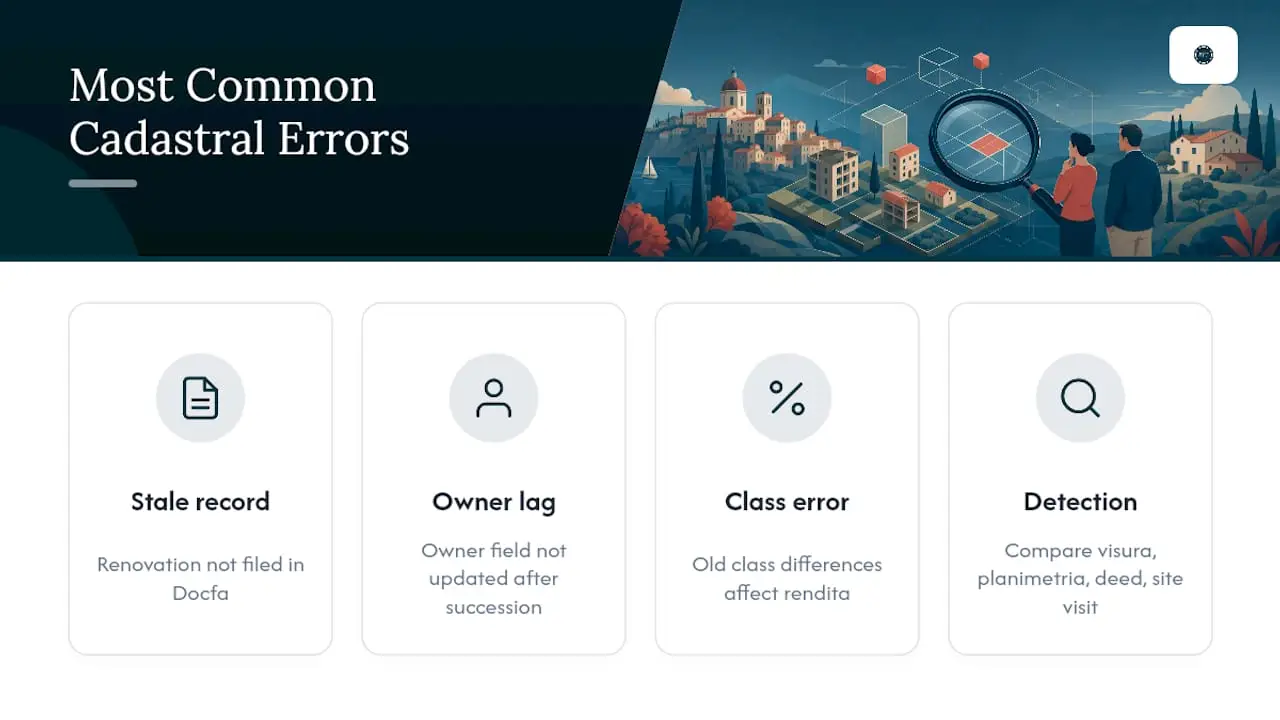
The most frequent issue is a stale record: a renovation, extension, or change of use that happened years ago but was never filed through Docfa, leaving the visura describing a version of the property that no longer exists. Buyers relying on the planimetria without a physical walkthrough often discover the mismatch only after closing.
A second common error involves the intestatario field lagging an inheritance or sale. When heirs skip a formal cadastral update after settling a succession, the visura can still show a deceased owner’s name years after the legal transfer, which then complicates the chain of title for the next sale.
Class misassignment is a subtler problem. Two similar units sometimes carry different classes for reasons no longer documented, typically an assessment made decades ago that was never revisited. This affects the rendita and, therefore, the tax bill, without any actual defect in the property itself.
To catch these, compare the visura against the planimetria, the deed, and, where possible, a recent site visit. Discrepancies between what the paper says and what actually exists on the ground are the single most common trigger for a notary flagging a transaction for closer review before signing.
Who Updates Cadastral Records Besides Docfa?
Docfa handles building updates filed by private professionals, but it is not the only channel that changes what appears in the cadastre.
Municipalities themselves can trigger updates when they approve building permits or change-of-use authorizations that affect a property’s classification, feeding information back to the Agenzia delle Entrate through administrative channels separate from a Docfa filing. Court-ordered updates also occur, particularly after inheritance disputes or judicial partitions that reassign ownership shares.
For land parcels rather than buildings, updates to the terreni cadastre often follow agricultural reclassification decisions made at the regional or provincial level, which then propagate into the national system. The Agenzia delle Entrate itself can also initiate a reassessment independently, particularly during periodic revaluation campaigns affecting entire cadastral zones rather than individual units.
Understanding which authority triggered a given update matters during due diligence, since a change originating from a municipal permit carries a different documentation trail than one filed directly by a property owner’s surveyor.
How Do Cadastral Categories Interact with Zoning Rules?
Cadastral category and municipal zoning (the piano regolatore or newer PGT frameworks) answer different questions, and conflating them is one of the more expensive mistakes an international buyer can make.
The cadastre tells you what a unit is currently registered as. Zoning tells you what activities the municipality actually permits on that parcel or in that building. A property can carry a commercial C/1 category while sitting in a zone that no longer permits new retail activity, meaning an existing shop might continue to operate under grandfathered rights while a buyer planning a different commercial use entirely could be blocked.
This is precisely why a Docfa filing to change a cadastral category should never happen in isolation. Municipal planning compatibility needs to be confirmed first, since the local authority, not the Agenzia delle Entrate, decides whether a proposed change of use is even permitted at that address. A cadastral update filed without that planning clearance can leave a property with a category that does not match what the municipality will actually allow, which surfaces as a serious complication the next time anyone tries to sell, finance, or renovate the unit.
An Author’s Perspective on Cadastral Due Diligence
The mistake I see foreign buyers make most often is treating the visura as proof of ownership. It is not. Cadastral checks answer fiscal questions; only a deed search through the Conservatoria answers legal ones, and a competent notary runs both in parallel, never one instead of the other. Remote review and English-language explanation remove the two biggest obstacles international buyers face: distance and jargon. Bring a notary in before you sign a preliminary agreement, not after a problem surfaces.
— Living
How Notaryinitaly Verifies Your Property Before You Sign
Notaryinitaly is the alternative to hiring separate local advisors for each step of an Italian purchase, since Cerini Notary Office handles cadastral verification, deed review, and closing under one English-speaking engagement, wherever in the world you are calling from.

The firm’s remote notary services let international clients complete title checks, review visure and planimetrie, and sign powers of attorney without traveling to Italy, closing the gap that usually forces foreign buyers to rely on local intermediaries they cannot fully vet. For the purchase itself, the real estate notary service covers the full transaction, cross-checking the cadastral record against the deed of provenance before a euro changes hands. If your situation involves cadastral discrepancies, a change of use in progress, or ownership questions tied to an inheritance, contact Notaryinitaly at ngcerini@notaryinitaly.com for a consultation on your specific case, or start with the English-speaking notary service page to see how the process works before you commit to an offer.
Recommended
- Best Italian Property Due Diligence Checks
- Property Taxes in Italy for Foreign Buyers
- Buying Property in Italy as a Foreigner: Step-by-Step Legal Guide
The information provided here is general in nature and does not replace professional assistance. Reading this content does not create a professional-client relationship.