
To buy property in Italy, you need a valid passport, an Italian tax code known as a codice fiscale, proof of funds, and, if you’re buying remotely, a notarized power of attorney. Priority one, before you send a single euro of deposit, is getting your codice fiscale and appointing a notaio. Non-EU nationals also need their home country checked against Italy’s reciprocity rules, and no purchase, however large, grants you Italian residency or citizenship on its own.
TL;DR:
- Securing a codice fiscale is essential and can be completed in a day in Italy or take up to four weeks through an Italian consulate abroad.
- Non-EU buyers must verify reciprocity with Italy, a process that often adds two to three weeks to the purchase timeline.
- Gathering and submitting the correct documents in three stages—before viewing, before signing the preliminary contract, and before the final deed—is crucial to avoid delays.
- A precisely drafted, apostilled power of attorney is vital for remote buyers to ensure their representative can act on their behalf during signing.
- The entire purchase process, from offer to final deed, can be managed remotely with an English-speaking notary who handles all legal steps and document coordination.
Table of Contents
- What Documents Do Foreign Buyers Need in Italy?
- How Does the Purchase Process Work Step by Step?
- What Taxes and Fees Should Foreign Buyers Budget For?
- Who Is Eligible to Buy Property in Italy as a Foreigner?
- Buying Remotely: What Changes When You Can’t Be in Italy?
- What the Cerini Team Wants Every Foreign Buyer to Know
- How Cerini Notary Office Supports Foreign Buyers
- Where to Verify These Rules Yourself
- Sources
- FAQ
What Documents Do Foreign Buyers Need in Italy?
You need five things in hand before you get anywhere near a deposit: a valid passport, a codice fiscale, documented proof of funds or bank statements, certified translations of any foreign ID or civil documents that require them, and a notaio or English-speaking legal representative already engaged. That last item surprises a lot of buyers who assume the notary only shows up at the end. In Italy, the notaio is involved from the due diligence stage onward, not just the signing ceremony.
The codice fiscale is the document that trips up more foreign buyers than any other single requirement. You cannot open an Italian bank account, sign a preliminary contract, or complete the final deed without one. The good news: if you request it in person at an Agenzia delle Entrate office in Italy, it’s usually issued same-day. Apply through an Italian consulate abroad instead, and you’re often looking at one to four weeks for processing. Buyers who wait to request it until after they’ve found a property routinely lose weeks they didn’t budget for.
Reciprocity is the second checkpoint non-EU buyers cannot skip. This isn’t a formality; it determines whether you’re legally permitted to buy at all, and the notaio confirms it before the deed is drafted.
Building your buyer’s document folder
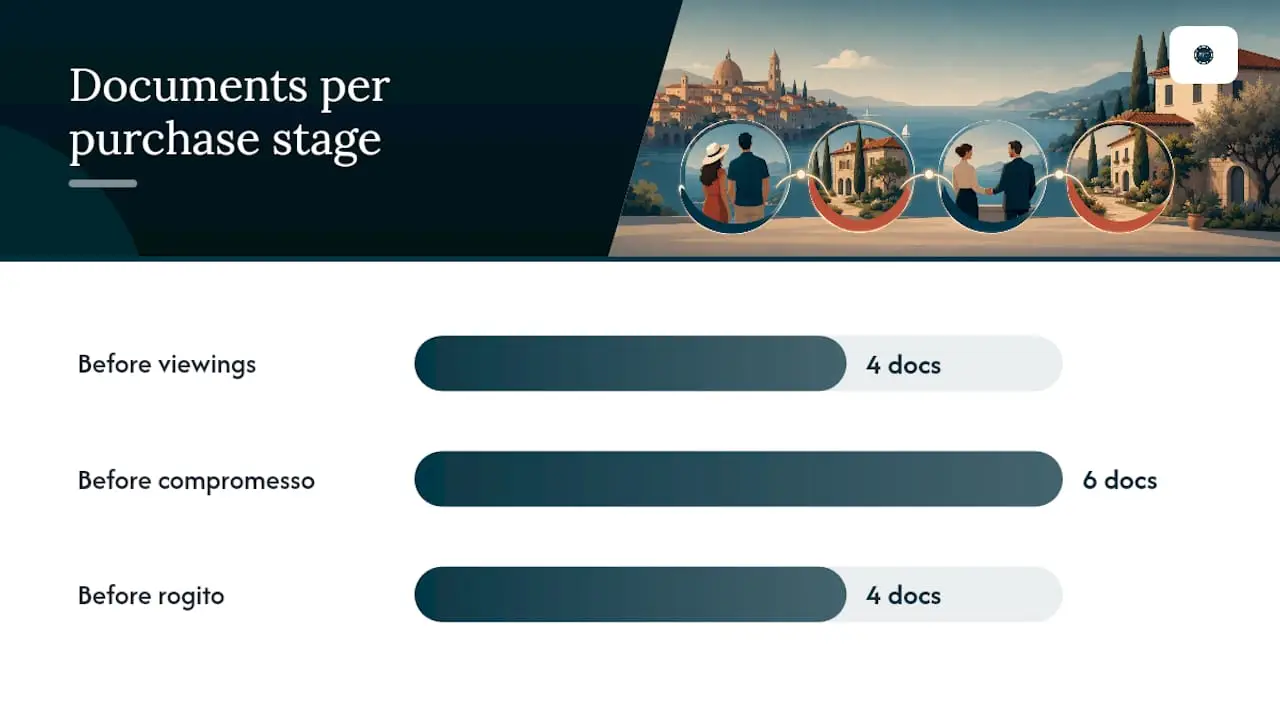
Assemble your documents in three tiers, matched to the three stages of an Italian purchase: before you view properties seriously, before you sign the compromesso (preliminary contract), and before the rogito (final deed).
Before viewing and making offers:
- Valid passport and, where relevant, a current visa or residence permit
- Codice fiscale (get this first; it unlocks everything else)
- Proof of funds: recent bank statements or a mortgage pre-approval letter
- Certified translations of your passport or ID, if your notary or bank requests them
Before signing the compromesso:
- Draft preliminary contract terms in writing, reviewed by your legal representative
- Visura catastale (land-registry extract) and planimetria (floor plan) requested from the seller
- Copy of the seller’s previous deed of purchase, to confirm chain of title
- Condominium meeting minutes from the last three years, if the property is part of a shared building
- Urban planning and building compliance certificates, particularly for older or renovated properties
Before the rogito:
- Original passport (or certified copy if buying by proxy) presented for identity verification
- Finalized, apostilled power of attorney, if you cannot attend in person
- Marriage certificate and, where relevant, proof of your matrimonial property regime
- Bank transfer confirmations and source-of-funds documentation for the notary’s escrow account
Civil status documents matter more than most buyers expect. If you’re married, the notary needs to know your matrimonial property regime, because Italian law treats jointly purchased assets differently depending on whether you’re under a community-of-property arrangement or a separate-property one. Getting this wrong on paper can complicate a future resale or inheritance.
Any foreign document not already in Italian, or not issued by an Italian authority, generally needs either an apostille (for countries in the Hague Convention) or consular legalization, plus a certified translation. Powers of attorney signed abroad almost always need both.
| Purchase Stage | Documents Required | Who Requests It |
|---|---|---|
| Before viewings | Passport, codice fiscale, proof of funds | Buyer |
| Before compromesso | Visura catastale, planimetria, prior deed, condo minutes | Notaio / agent, on buyer’s request |
| Before rogito | Apostilled POA, translations, wire confirmations, marriage certificate | Buyer, with notaio review |
How Does the Purchase Process Work Step by Step?
The Italian purchase process runs in four distinct stages, and each one has its own document demands. Understanding the order matters more than most buyers realize, because skipping ahead (signing a compromesso before your codice fiscale exists, for instance) creates delays that ripple through the whole transaction.
-
Proposta (offer). You submit a written offer, usually accompanied by a modest good-faith deposit. This isn’t yet binding in the way a compromesso is, but it typically locks the seller out of negotiating with other buyers for a set period. Attach proof of funds here if the seller’s agent requests it, since it strengthens your offer.
-
Compromesso (preliminary contract). Once your offer is accepted, you sign the compromesso and pay a deposit, commonly between 10% and 30% of the purchase price. This is the point where conditional clauses matter: a mortgage contingency, a satisfactory survey result, or confirmation of planning compliance. Registering the compromesso protects your deposit and your claim on the property if the seller tries to back out or the property is later encumbered.
-
Due diligence. Between the compromesso and the rogito, your notaio (and often a geometra, Italy’s licensed building surveyor) runs the searches that determine whether the deed can safely proceed. This includes visure ipotecarie (mortgage and lien searches), catastali (cadastral records), and a check that the property’s physical state matches its registered planimetria. Since 2010, sellers have been legally required to declare that the property matches its cadastral floor plan, and a mismatch discovered late can delay or even void the deed unless corrected first.
-
Rogito (final deed). This is the signing itself, performed in the notaio’s office, with the notary reading the deed aloud and confirming both parties understand its terms. You present your passport (or your attorney presents it, if you’ve granted a power of attorney), the balance of funds moves through the notary’s escrow arrangement, and the notaio registers the transfer with the Conservatoria and Catasto immediately afterward. The notary’s role here carries personal liability: they’re guaranteeing the deed’s legal validity, not simply witnessing signatures.
Pro Tip: Get your codice fiscale before you make any written offer, not after. Buyers who wait until the compromesso stage to request it often finds themselves negotiating deadlines with a seller while still waiting on consulate paperwork.
Timelines vary, but three bottlenecks show up again and again: codice fiscale delays through consulates abroad, bank know-your-customer (KYC) checks for non-resident accounts, and reciprocity verification for non-EU buyers, which typically adds two to three weeks. Budget for all three from day one rather than discovering them mid-transaction.
What Taxes and Fees Should Foreign Buyers Budget For?
Foreign buyers purchasing a second home in Italy should budget for closing costs between 10% and 15% of the purchase price, according to Italy’s Ministry of Foreign Affairs. That range covers registration tax, notary fees, and the smaller flat charges layered on top.
Registration tax is the largest single line item, and it depends heavily on residency status. Buyers registering the property as their prima casa (primary residence) within 18 months of the deed pay a reduced rate, while second-home buyers pay a materially higher one, often calculated on the property’s cadastral value rather than the purchase price. If you’re buying directly from a construction company rather than a private seller, VAT (IVA) may apply instead of the standard registration tax, and luxury or non-primary-residence purchases carry a higher IVA rate.
Beyond registration tax, plan for:
- Cadastral and mortgage registry flat fees, generally modest and fixed regardless of price
- Notary fees, often a small percentage of the purchase price, scaled to the property’s value and deed complexity
- Geometra survey fees for compliance and planimetria checks
- Independent legal fees if you retain your own avvocato alongside the notaio
- Certified translation and apostille costs for any foreign documents
Moving your official residence to Italy within 18 months of signing can shift you into prima casa tax treatment retroactively in some cases, which is worth discussing with your notaio before the deed is finalized rather than after. The notary fee and tax breakdown covers the specific rate bands in more depth if you want to model your own numbers before making an offer.
Who Is Eligible to Buy Property in Italy as a Foreigner?
EU and EFTA citizens buy property in Italy under the same rules as Italian nationals. You’ll still need a codice fiscale and the standard document packet, but there’s no reciprocity check to clear.
Non-EU buyers face a different threshold: the principle of reciprocity. Italy permits a citizen of another country to buy real estate here only if that country extends the same right to Italian citizens. In practice, this covers most Western countries, including the United States, Canada, and the United Kingdom, but the notaio is required to verify it against the Ministry of Foreign Affairs reciprocity tables before the deed can proceed. Build in an extra two to three weeks for this confirmation on a standard file.
A few practical points worth knowing before you assume you need a workaround:
- Italy’s investor visa (art. 26-bis) exists for large capital investments in Italian businesses or government bonds, but it is rarely the relevant route for a standard property purchase; it solves a residency problem, not a reciprocity one.
- Buying through an Italian company is sometimes proposed as a workaround for reciprocity restrictions, but it introduces its own incorporation paperwork and doesn’t eliminate the underlying documentation burden.
- Obtaining Italian residency independently of the purchase can simplify reciprocity questions for some nationalities, though it’s a longer path and shouldn’t be pursued solely to buy one property.
For the overwhelming majority of foreign buyers from reciprocity-eligible countries, the practical answer is simpler than any workaround: confirm eligibility early with your notaio and let the standard document process run its course.
Buying Remotely: What Changes When You Can’t Be in Italy?
Buying from abroad is common and entirely workable, but it hinges on one document doing a lot of legal weight: your power of attorney (procura). A properly drafted procura lets your notaio or a trusted representative sign on your behalf at the rogito, provided the document itself has been apostilled and, where the original isn’t in Italian, accompanied by a certified translation.

The wording matters more than buyers expect. A procura that’s too narrow can block your representative from handling a clause that comes up unexpectedly at signing, while one that’s properly scoped covers the deed, related tax filings, and registration steps in a single document. This is a case where a template drafted by someone unfamiliar with Italian notarial practice can cause more problems than it solves.
Funds transfers from abroad also draw closer scrutiny. Banks require traceable SWIFT wires and expect enhanced anti-money-laundering and source-of-funds documentation for non-resident buyers, so gather bank statements and, if applicable, evidence of the sale of assets that funded the purchase well before you’re at the wire stage.
- Prepare a single authenticated dossier: apostilled passport copy, certified translations, a clearly scoped POA, and proof of funds, bundled together rather than sent piecemeal.
- Confirm with your bank early which AML documentation they’ll require for a non-resident wire; requirements vary by institution and can add days if requested late.
- Use a courier service with tracking for any original documents that must physically reach Italy, and keep certified copies for your own records.
Pro Tip: Send your entire document dossier to your notaio in one batch rather than trickling documents in as you gather them. Notaries working remote files report that scattered document delivery is the single biggest cause of delayed rogito dates.
An English-speaking notary who regularly handles remote purchase files can flag a poorly worded POA before it becomes a problem at signing, not after you’ve already flown home.
What the Cerini Team Wants Every Foreign Buyer to Know
Order of operations decides more outcomes than legal knowledge does. We consistently see buyers who understood Italian property law reasonably well still lose time, and occasionally deposits, because they signed a compromesso before their codice fiscale existed or before anyone checked reciprocity.
The fix isn’t complicated. Get your codice fiscale and appoint your notaio before you make an offer, not after. Have your legal representative review the compromesso’s conditional clauses before you sign, since that document, not the rogito, is where deposit protection actually gets decided. And if you’re buying remotely, get your power of attorney drafted and apostilled early, because that document, more than any other, determines whether your closing date holds.
Three things to do this week: request your codice fiscale, identify and contact a notaio, and start gathering your proof-of-funds documentation before you need it.
— team
How Cerini Notary Office Supports Foreign Buyers
Notaryinitaly is the practical alternative to piecing together a purchase through disconnected local contacts. Where a traditional path often means chasing a notary who speaks limited English, a separate translator, and a lawyer working in a different time zone, Cerini Notary Office runs all of it, remotely, in English, from a single point of contact.
A first consultation typically covers a review of your document dossier, a realistic timeline estimate given your nationality and reciprocity status, and identification of any gaps before they become delays at the compromesso or rogito stage. The firm handles the notarial work directly: drafting and legalizing powers of attorney for buyers who can’t travel, coordinating rogito-by-proxy signings, and managing escrow arrangements so funds move on a documented, verifiable trail rather than an informal handshake. For buyers weighing whether to travel or sign remotely, the English-speaking notary service for Italian real estate explains exactly which parts of the closing can be handled by proxy.
If you’re preparing to make an offer, or you already have a compromesso deadline approaching, contact the office directly at ngcerini@notaryinitaly.com or start with the purchase and sale notarial assistance page to request a document review and timeline estimate for your specific case.
Where to Verify These Rules Yourself
Check property tax and codice fiscale procedures directly with Agenzia delle Entrate, which also publishes market value data through its OMI observatory. The Consiglio Nazionale del Notariato outlines a notary’s legal duties in a sale, and MAECI maintains the reciprocity tables governing non-EU eligibility.
This article is general information, not a substitute for advice from a qualified lawyer. Consult a qualified legal professional about your own circumstances before acting on anything here.
Sources
- Buying property in Italy as a foreigner (official guide)
- Purchase and sale of real estate — Consiglio Nazionale del Notariato
- Buy property in Italy as a foreigner (guide)
FAQ
Can foreigners purchase property in Italy?
Yes. EU and EFTA citizens buy under the same rules as Italians, and non-EU citizens can buy as long as their home country grants Italians the same right, a principle known as reciprocity, which the notaio verifies before the deed.
Do I automatically become an Italian citizen by buying property in Italy?
No. Purchasing property carries no citizenship or residency rights on its own; you’d need to pursue residency or citizenship through entirely separate legal processes.
Is Italy offering $30,000 to move there?
No verified national program offers a large flat payment to relocate to Italy; some Italian municipalities have run small-scale incentive schemes for repopulating specific towns, but these are local, limited, and unrelated to standard property purchases.
What documents do I need to get a codice fiscale?
You need a valid passport or ID and a completed application form, submitted either at an Agenzia delle Entrate office in Italy for same-day issuance or through an Italian consulate abroad, which can take one to four weeks.
How long does the reciprocity check take for non-EU buyers?
The notaio’s verification against MAECI reciprocity tables typically adds two to three weeks to a standard purchase timeline for non-EU nationals.
Can I sign the final deed if I can’t travel to Italy?
Yes, by granting a notarized, apostilled power of attorney to a representative, such as your notaio, who can sign the rogito on your behalf; Cerini Notary Office’s remote services are built specifically around this workflow for foreign buyers.
Recommended
- Italy Property Closing Process for Foreigners
- 7 Top Mistakes Foreign Buyers Make
- Italian Deed Signing for Foreigners Explained
- Buying Property in Italy as a Foreigner: Step-by-Step Legal Guide
The information provided here is general in nature and does not replace professional assistance. Reading this content does not create a professional-client relationship.