
Cadastral income (rendita catastale) is the official tax base for Italian property taxes, not the market value, and it determines what you owe for IMU, registration tax, and inheritance tax alike. You find it on a visura catastale issued by the Agenzia delle Entrate. If a figure on that document looks off or you are buying from abroad, a notary can verify it before you sign anything.
TL;DR:
- Most property taxes in Italy use cadastral income, which is fixed and often significantly below the property’s market value, especially in cities.
- The cadastral value is calculated by multiplying the property’s rendita catastale by a 5% revaluation and a specific coefficient depending on the tax type.
- Using the correct coefficient for each tax is crucial, as IMU and registration tax coefficients vary widely and are not interchangeable.
- Foreign buyers should verify their cadastral income with a recent visura catastale, as outdated figures can lead to costly tax miscalculations.
- Most mistakes stem from confusing coefficients or relying on outdated information, making professional verification essential for accurate tax reporting.
Table of Contents
- What Is Cadastral Income in Italy and How Does It Differ From Market Value?
- How Do You Find Your Property’s Cadastral Income?
- How Do You Calculate Cadastral Value From Cadastral Income?
- Which Italian Taxes Use Cadastral Value?
- What Mistakes Should You Avoid With Cadastral Income Calculations?
- How Cerini Notary Office Helps You Navigate Cadastral Income
- Why Most Guides Get Cadastral Income Backwards
- Sources
What Is Cadastral Income in Italy and How Does It Differ From Market Value?
Cadastral income is a fixed annual value assigned to each Italian property by the Agenzia delle Entrate, and it exists purely as a tax reference point. It has nothing to do with what your apartment would fetch on Idealista or what a buyer actually paid at closing.
The number comes from three inputs recorded in the land registry: the property’s cadastral category (residential, commercial, agricultural, and so on), its class within that category (a rough quality tier based on location and condition), and its consistency (a size measure, expressed in rooms for houses or square meters for commercial units). Multiply these together using rates set by the cadastral office and you get the rendita catastale.
Italy built the system this way for a reason. A fixed, slow-moving figure gives tax authorities and property owners a predictable base, one that does not swing with every market cycle. The tradeoff is that cadastral income routinely sits well below market value, sometimes by half or more, especially in cities where prices have climbed for years while cadastral categories have not been updated.
- Category and class drive most of the variation between similar-looking properties
- Consistency (size) multiplies the base rate to produce the final rendita
- The figure changes only when the property is reclassified or renovated
How Do You Find Your Property’s Cadastral Income?
The fastest route is a visura catastale, and you have three practical ways to get one.
- Request it online. Property owners can pull a visura catastale free of charge through the Agenzia delle Entrate portal using SPID or CIE digital identity credentials.
- Check the notarial deed. Every Italian purchase deed lists the cadastral data, including section, sheet, subordinate (sub), and the rendita itself, so a past deed often has the number already.
- Ask a professional to pull it for you. A notary, geometra, or accountant can retrieve the visura on your behalf when you lack SPID access.
That third option matters more than it sounds. Most foreign buyers do not have an Italian digital identity, which makes the self-service portal effectively closed to them.
Pro Tip: Do not assume the rendita on an old deed still matches today’s cadastral records. Renovations, subdivisions, or category reclassifications can change it, so always request a fresh visura before you calculate any tax.
How Do You Calculate Cadastral Value From Cadastral Income?
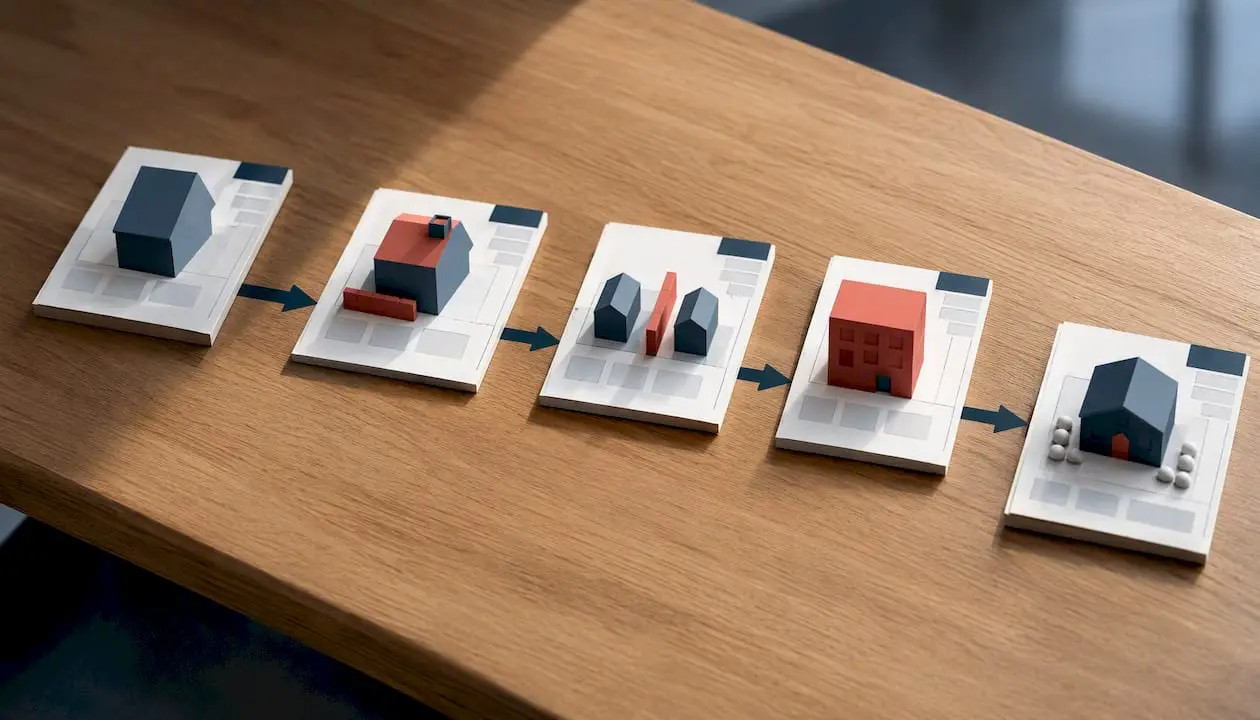
The formula is short, but it trips people up because the multiplier changes depending on which tax you are calculating. Start with the rendita catastale shown on the visura, revalue it by 5%, then multiply by the coefficient tied to the specific tax.

Cadastral value = Rendita catastale × 1.05 × coefficient
The 5% revaluation step applies almost universally before any multiplication happens, a detail Agenzia delle Entrate confirms as standard cadastral procedure. The coefficient after that is where the numbers diverge.
| Purpose | Property Type | Typical Coefficient |
|---|---|---|
| IMU calculation | Most residential properties | 160 |
| Registration tax (prezzo-valore) | Primary residence purchase | Lower coefficient, often near 115.5 |
| Registration tax (prezzo-valore) | Second home purchase | Higher coefficient than primary residence |
These figures come from Agenzia delle Entrate guidance and are echoed in practitioner breakdowns from idealista, though exact coefficients can shift depending on cadastral category, so verify against current guidance before filing.
Worked example A, primary residence registration tax: a rendita catastale of $500 revalues to $525 (500 × 1.05). Apply a primary-residence coefficient near 115.5, and the cadastral value lands around $60,637. Registration tax at 2% (a rate we cover below) applies to that figure, not to the purchase price.
Worked example B, second home IMU: the same $500 rendita revalues to $525, then multiplies by 160 for IMU purposes, producing a cadastral value of $84,000. Your municipality’s IMU rate applies to that number, not to the $525 or the property’s market price.
- Always confirm which tax you are calculating before choosing a coefficient
- IMU and registration tax coefficients are not interchangeable
- The 5% revaluation happens first, in every case
The gap between those two worked examples, $60,637 versus $84,000 from the identical starting rendita, shows exactly why mixing up coefficients produces real financial errors.
Which Italian Taxes Use Cadastral Value?
Cadastral value feeds four distinct tax calculations, and each one treats it differently.
- IMU (municipal property tax): owed on second homes and luxury-category primary residences; ordinary primary residences are generally exempt. Municipalities set their own rate within national bounds, and many push toward the upper end of that range, so the same cadastral value can produce noticeably different bills in different comuni.
- Registration tax: under the prezzo-valore system, private sales between individuals can be taxed on cadastral value rather than declared price, often lowering the bill. Typical rates run 2% for a qualifying primary residence and 9% for a second home, each with statutory minimums.
- Inheritance and gift tax: cadastral value serves as the taxable base for real estate passed on to heirs, with rates and exemption thresholds depending on the relationship between the deceased and the beneficiary.
- TARI and deemed rental income: TARI (waste collection tax) uses property size rather than cadastral value directly, while unoccupied second homes can trigger deemed rental income taxation based partly on cadastral figures.
Non-residents face all four categories the same way residents do, with one added wrinkle: without an Italian tax representative on the ground, tracking deadlines and payment methods from abroad becomes considerably harder. Our guide to property taxes for foreign buyers covers the resident versus non-resident distinctions in more depth.
What Mistakes Should You Avoid With Cadastral Income Calculations?
Italy’s tax system runs on self-reporting. No agency mails you an invoice for IMU. You calculate it, then pay it yourself through the F24 payment form, and missing that step brings penalties and interest, not a grace period.
The most common error is coefficient confusion: using the IMU multiplier of 160 when you should have used a lower prezzo-valore coefficient for registration tax, or the reverse. Specialist legal analysis confirms this mix-up is one of the most frequent and costly mistakes buyers make on their own.
- Confirm which tax you are calculating before selecting a coefficient
- Request a fresh visura catastale rather than relying on an old deed
- If you built or renovated, request cadastral reassignment within 30 days of the property becoming habitable
- Gather deed copies, prior visure, and renovation permits before closing or filing IMU
Pro Tip: Set a calendar reminder for IMU payment deadlines the moment you close on a property. There is no reminder letter coming from the comune.
How Cerini Notary Office Helps You Navigate Cadastral Income
Foreign buyers rarely have SPID credentials, and international investors closing from another time zone cannot always chase down a visura on their own schedule. That is precisely the gap Cerini Notary Office fills.
- Retrieving and verifying the visura catastale before you sign
- Advising on which coefficient applies to your specific IMU or registration tax scenario
- Handling the prezzo-valore election at closing when it benefits you
- Delivering all of the above through remote services and full English-speaking support, so distance and language never become obstacles
| What you need | How Cerini Notary Office addresses it |
|---|---|
| Verify cadastral income before closing | Retrieves and cross-checks the visura catastale directly |
| Calculate correct tax base | Applies the right coefficient for IMU vs. registration tax |
| Close from abroad without SPID | Offers remote notarial services with English-language support |
| Understand prima casa or prezzo-valore eligibility | Advises on election options at the deed stage |
A notary handling your property purchase folds the cadastral verification directly into the deed, which locks in your tax treatment before any dispute can arise later.
Official links and authoritative resources
Agenzia delle Entrate cadastral services for definitions and procedures. Remote notary services for foreigners for closings handled from abroad. Notary fees guide for full cost breakdowns.
Why Most Guides Get Cadastral Income Backwards
Most explainers treat cadastral income as a trivia question, a quirky Italian number you look up once and forget. That framing undersells what is actually at stake. Get the coefficient wrong on a second home purchase and you might overpay registration tax by a meaningful margin, or worse, underpay and face penalties years later when the comune catches up.
The conventional advice tells readers to “check the visura” and stops there, as if retrieval were the hard part. It isn’t. The hard part is knowing which of several coefficients applies to your specific transaction, and that decision depends on details, property category, residency status, whether you are calculating IMU or registration tax, that a generic guide cannot account for.
If you take one thing from this explainer, prioritize verification over speed. A rendita catastale confirmed by a professional before closing costs you a small amount of time. An unverified figure that turns out wrong costs you a corrected filing, penalty interest, and possibly a renegotiated deed. For international buyers working across time zones and legal systems they didn’t grow up with, that verification step is the one place where paying for expertise buys real protection, not just convenience.
— Living
For a review of your specific cadastral income situation, whether you are closing on a purchase, settling an inheritance, or simply confirming your current tax exposure, contact Cerini Notary Office at ngcerini@notaryinitaly.com. Our English-speaking notary services are built for exactly this kind of case-specific verification, delivered remotely wherever you are.
Sources
- Cadastral services – Agenzia delle Entrate
- What is the cadastral value of a property and how is it calculated? – idealista
- IMU: who has to pay Italy’s property tax – The Local
- Italian cadastral value: how it’s calculated for property tax – LegalClarity
Recommended
- Italian Notary Fees
- Property Taxes in Italy for Foreign Buyers
- Buying Property in Italy as a Foreigner: Step-by-Step Legal Guide
The information provided here is general in nature and does not replace professional assistance. Reading this content does not create a professional-client relationship.