
A representative office in Italy is a non-commercial presence for promotion, market research, and liaison work only. It cannot invoice or sign binding commercial contracts. Register it at the local Chamber of Commerce, obtain a tax code, and document its non-commercial activity carefully. The first move is gathering your home-jurisdiction corporate certificates and speaking with a notary or legal adviser before you file anything in Italy, since a poorly documented setup is exactly what triggers a permanent-establishment reclassification later.
TL;DR:
- A representative office in Italy must strictly avoid conducting or signing any transaction that generates revenue or involves inventory to prevent reclassification as a permanent establishment.
- Registration involves extensive documentation including apostilled certificates, sworn translations, and proof of a local address, with translation errors causing significant delays.
- Staff working in Italy trigger tax residency and social security obligations once they stay over 183 days, with employment registration and compliance steps often overlooked by foreign companies.
- The office cannot secure an Italian visa or residence permit, and staff transfers depend on intra-company secondments or standard work visas, not a special rep office visa.
- Choosing a branch or subsidiary is advisable as soon as local invoicing, contract authority, or revenue is expected within 12 months, since a rep office cannot handle such activities legally or tax-wise.
Table of Contents
- What Is a Representative Office in Italy?
- How Do You Register a Representative Office With the Chamber of Commerce?
- What Tax and Permanent Establishment Risks Should You Watch For?
- What Are the Payroll and Social Security Rules for Staff in Italy?
- Does Opening a Representative Office Get You an Italian Visa?
- When Should You Choose a Branch or Subsidiary Instead?
- What Is the Realistic Timeline and Cost to Set Up?
- How Cerini Notary Office Reduces Setup Risk and Delay
- Ready to Set Up Your Representative Office the Right Way?
- The Gap Between the Online Playbook and What Actually Works
- Sources
What Is a Representative Office in Italy?
A representative office has no independent legal personality. It functions as a cost center, an extension of the foreign parent company rather than a separate Italian entity. That distinction shapes everything else: tax treatment, contracting authority, and even how staff get paid.
The office exists to promote the parent’s brand, gather market intelligence, and maintain relationships, not to close deals. Permitted activities include:
- Market research and competitor analysis
- Promotional activity and brand representation at trade shows
- Liaison between the parent company and Italian contacts
- Information gathering and reporting back to headquarters
Prohibited activities are anything transactional: signing sales contracts, issuing invoices, negotiating binding terms, or holding inventory for delivery. Cross that line and Italian tax authorities can reclassify the office as a permanent establishment, which exposes the parent to corporate income tax and VAT on activity that was never supposed to be taxable in Italy in the first place.
How Do You Register a Representative Office With the Chamber of Commerce?
Registration runs through the Economic and Administrative Index, known as REA, filed at the territorial Chamber of Commerce covering the office’s location. The filing itself is straightforward once your documents are in order, but assembling those documents from a foreign jurisdiction is where most delays happen.
You will typically need to prepare:
- Certificate of incorporation or registration from the home country
- Certificates confirming the identity of legal representatives
- Apostille or consular legalization, depending on whether the home country is a Hague Convention signatory
- Sworn Italian translations of every foreign-language document
- A power of attorney naming a local representative
- Proof of a registered office address in Italy
| Requirement | Document or Action Needed |
|---|---|
| Legal existence proof | Certificate of incorporation, translated and legalized |
| Signatory authority | Power of attorney for the local representative |
| Document authenticity | Apostille (Hague countries) or consular legalization (non-Hague) |
| Local presence | Registered office address, lease or hosting agreement |
| Tax identification | Codice fiscale application filed with the Agenzia delle Entrate |
Sworn translations matter more than most foreign founders expect. A certificate that reads perfectly in English but arrives without a certified Italian translation, or with the wrong legalization path, gets bounced back by the Chamber, and that single rejection can add weeks to your timeline. Non-EU companies frequently need embassy-issued attestations on top of the apostille, so confirm the exact chain your home country requires before you start collecting paperwork.
What Tax and Permanent Establishment Risks Should You Watch For?
A rep office that stays within its non-transactional lane is generally not subject to Italian corporate tax or VAT; however, tax treatment of representative offices is jurisdiction-specific and requires careful consideration, as explained in this UAE Corporate Tax Registration: A Guide For Business Owners. The moment it starts behaving like a business rather than a liaison desk, that protection disappears.
Specific red flags that trigger reclassification include:
- Signing contracts with Italian counterparties on the parent’s behalf
- Issuing invoices or accepting payment locally
- Storing or distributing goods from the Italian address
- Ongoing, revenue-generating negotiations conducted from the office
- Delegating contracting authority to local staff
Pro Tip: Keep every negotiation that could lead to revenue routed back to the parent company outside Italy, with a written record showing the local representative had no authority to conclude the deal. That paper trail is your strongest defense if the Agenzia delle Entrate ever questions the office’s status.
Practical safeguards worth building in from day one: separate accounting for local expenses only, invoicing that always originates from the parent entity abroad, and a written limit on what the local representative can commit to. If your business plan calls for local revenue inside a year, converting to a branch or subsidiary before you open the doors saves you a painful retroactive tax fight.
What Are the Payroll and Social Security Rules for Staff in Italy?
Employees working in Italy become Italian tax residents once they cross the 183-day threshold in a tax year, which triggers Italian filing obligations and employer contributions to INPS, Italy’s social security institute.
Foreign companies generally choose among three staffing routes:
- Secondment of an existing employee from the parent company
- An employer-of-record arrangement that handles Italian payroll on your behalf
- Direct local recruitment through an Italian staffing agency
Whichever route you pick, you still need to register the employment relationship with the Centro per l’Impiego, maintain the Libro Unico del Lavoro (Italy’s mandatory labor ledger), and appoint a local social-security representative with power of attorney to handle INPS filings. Skipping this step is one of the more common compliance gaps foreign companies discover only after an inspection.
Does Opening a Representative Office Get You an Italian Visa?
No. There is no standalone “representative office visa” in Italian immigration law, despite what some online guides imply. Mobility for staff typically runs through intra-company secondment rules under Article 27-quinquies, or through the standard work-visa categories that apply to any foreign employer.
Secondment works when the employee is being transferred temporarily to a local unit, branch, or group entity, with the assignment’s terms, duration, and reporting line clearly documented. It does not work as a backdoor to residency for someone the parent company has no genuine intention of seconding under those rules.
Typical documents requested for a visa or residence-permit application include:
- Proof of employment with the parent company for a minimum period
- Secondment letter detailing role, duration, and salary
- The rep office’s REA registration and codice fiscale
- Evidence of adequate housing and financial means in Italy
Treat any online claim promising an easy visa simply because you opened a rep office as suspect. Verify the actual secondment conditions with a qualified adviser before you build a hiring plan around it.
When Should You Choose a Branch or Subsidiary Instead?
A representative office stops making sense the moment your Italian plans involve money changing hands locally. Three concrete situations should push you toward a different structure:
- You need to invoice Italian customers or hold stock for local delivery.
- Your local staff need authority to sign commercial contracts.
- You expect meaningful Italian revenue within the next 12 months.
A branch office carries fuller reporting obligations and direct tax exposure but lets you trade immediately under the parent’s name. A subsidiary, typically an SRL, creates a separate Italian legal entity with its own liability shield, at the cost of more setup time and ongoing compliance. Compare the SRL versus branch structures before committing, since the wrong choice here is expensive to unwind later. As a rule of thumb: if you can answer yes to any of the three situations above, budget for company incorporation rather than a rep office.
What Is the Realistic Timeline and Cost to Set Up?
Plan the sequence in parallel tracks rather than one long chain, since translations and legalization can happen while the Chamber filing is being prepared.
- Collect home-jurisdiction certificates and apostille or legalize them.
- Commission sworn Italian translations of every document.
- File the REA registration at the territorial Chamber of Commerce.
- Apply for the codice fiscale.
- Appoint your local representative and, if hiring, your social-security delegate.
- Certificate legalization and sworn translation: typically a few weeks, depending on your home country’s process
- Chamber of Commerce and REA filing: generally processed within weeks once documents are complete
- Ongoing monthly administration: bookkeeping, representative fees, and any payroll costs if staff are hired
Contact a notary early, since document defects caught before filing are far cheaper to fix than a rejected application. A sworn translator and the Chamber of Commerce are your two other essential contacts, and getting all three working from the same document checklist from day one avoids the back-and-forth that eats weeks of your timeline.
How Cerini Notary Office Reduces Setup Risk and Delay
Foreign companies rarely lose time to Italian bureaucracy itself. They lose it to translation mismatches, legalization chains they didn’t anticipate, and paperwork nobody on their end could read closely enough to catch errors in.
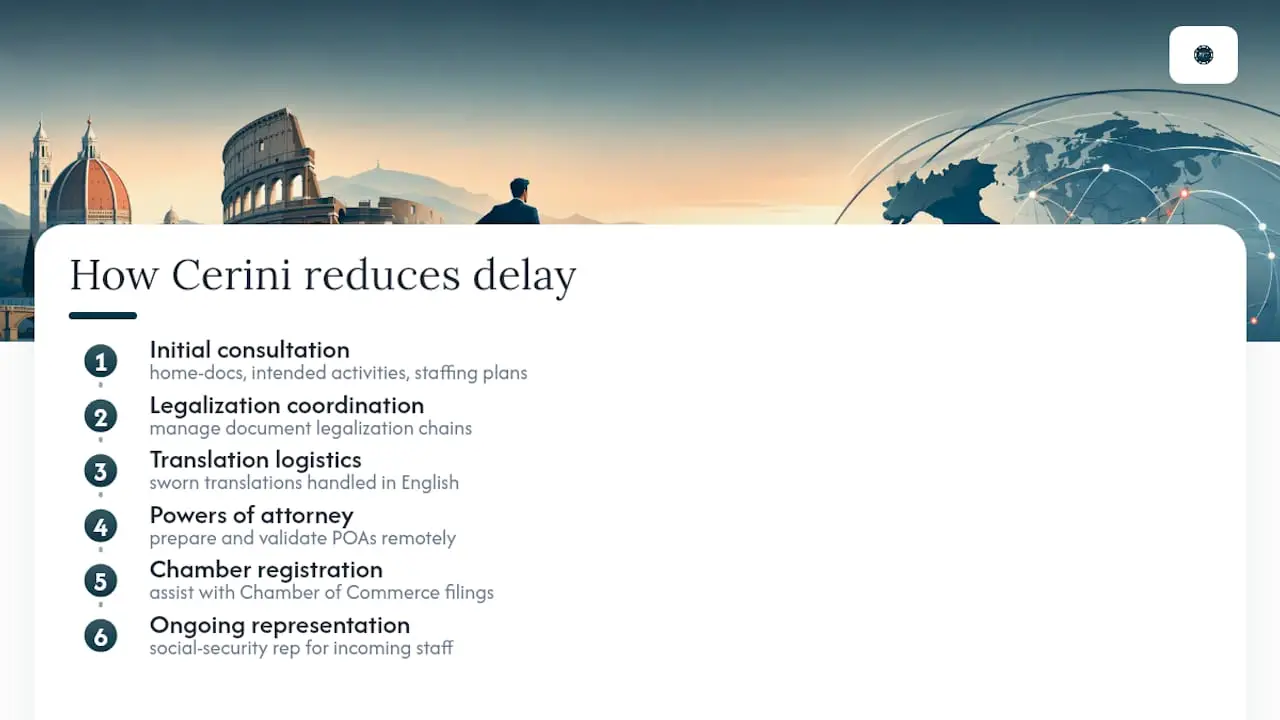
Notaryinitaly, through Cerini Notary Office, coordinates document legalization, sworn-translation logistics, powers of attorney, and Chamber of Commerce registration assistance for international clients, with social-security representation available for companies bringing staff into Italy. Every step runs in English, remotely, so a founder in Chicago or a general counsel in Singapore never has to fly to Italy to open a compliant rep office. An initial consultation typically covers your home-jurisdiction corporate documents, your intended activities in Italy, and your staffing plans, which is enough for the firm to map out exactly which certificates and translations you will need before you spend a euro on filings.
Ready to Set Up Your Representative Office the Right Way?
Notaryinitaly gives foreign companies a single, English-speaking point of contact for the entire setup instead of juggling a notary, a translator, and a Chamber of Commerce clerk across three time zones. That remote-first model means you can start the document review from your own office abroad, without waiting for a flight to Italy or a local intermediary to translate legal jargon back to you.
Cerini Notary Office handles document legalization, sworn-translation coordination, and remote notary services for representative offices, branches, and subsidiaries alike, so if your plans outgrow the rep office structure, the transition to an Italian company formation does not mean starting over with a new adviser. Every engagement is confidential, and fee estimates are quoted against your specific documents and timeline rather than a generic price list. Email ngcerini@notaryinitaly.com with an outline of your company’s home jurisdiction, intended Italian activities, and staffing plans, and you will get a case-specific consultation on the fastest, most compliant path forward.
The Gap Between the Online Playbook and What Actually Works
Most guidance on representative offices in Italy repeats the same three sentences: it’s cheap, it’s fast, it’s non-taxable. All true, and all beside the point for a company actually trying to decide whether this structure fits their situation.

The real question isn’t whether a rep office is allowed. It’s whether your local team can resist the pull toward commercial activity once they’re on the ground and a customer wants to buy something today. I’ve seen the pattern in how these arrangements get described by advisers who work with foreign companies daily: the office starts purely promotional, then someone signs a small order “just this once” to keep a client happy, and six months later there’s a pattern of behavior that looks exactly like a taxable presence to an auditor. The structure didn’t fail. The discipline around it did.
If there’s one piece of overlooked wisdom worth taking from this, it’s that a representative office is a governance exercise as much as a legal one. The paperwork is the easy part. The harder part is writing down, in advance, exactly what your local representative cannot do, and then actually enforcing that limit when a real opportunity shows up and the temptation to just close the deal becomes real. Companies that treat the rep office as a strict, temporary bridge to a future branch or subsidiary tend to do fine. Companies that treat it as a permanent, cost-free way to operate in Italy without paying Italian tax tend to be the ones who eventually hear from the Agenzia delle Entrate.
— Living
This article is general information, not a substitute for advice from a qualified lawyer. Consult a qualified legal professional about your own circumstances before acting on anything here.
Sources
- Impresainungiorno
- Establishing a representative office in Italy (local office) – Maltese Italian Chamber of Commerce
- Setting up a branch or a representative office in Italy: a guide for foreign companies – Bureau Plattner
- Italianvisa
Recommended
- Italian Company Formation for Foreign Investors
- Company Incorporation in Italy for Foreign Investors
- SRL vs Branch Italy for Foreign Businesses
- Company Setup With US Shareholders in Italy
The information provided here is general in nature and does not replace professional assistance. Reading this content does not create a professional-client relationship.