
If you plan to trade, invoice, or sign contracts in Italy, you need a branch. If you only want market research, promotion, or a liaison presence, a representative office covers you at a fraction of the cost and complexity. The dividing line matters because it determines your tax bill.
- A branch is a permanent establishment (PE), taxed on Italian profit at IRES plus IRAP.
- A representative office pays no IRES or IRAP if it stays strictly auxiliary, promotional, or preparatory.
- If you’re unsure which category your Italian activities fall into, talk to a notary or tax advisor before giving any local staff the authority to sign contracts.
Key Takeaways
| Point | Details |
|---|---|
| Match structure to activity | Choose a branch if you’ll sign contracts or invoice locally; choose a representative office for research and liaison only. |
| Tax gap is the deciding factor | Branches pay 24% IRES plus IRAP; rep offices pay neither if they stay strictly auxiliary. |
| Documentation prevents PE reclassification | Written limits on local staff authority and separate cost-center accounting protect rep office status. |
| Branch filings need a notary | Registro delle Imprese registration requires a notarial deed; REA registration for rep offices does not. |
| Notaryinitaly handles the notarial workload remotely | Cerini Notary Office coordinates apostilles, translations, and deeds in English for either structure. |
Table of Contents
- Branch vs Representative Office: The Core Legal Difference
- Who Is Liable, and Who Signs What?
- Registration Steps and the Document Checklist
- Tax and Payroll Obligations for Each Structure
- How a Representative Office Accidentally Becomes a Branch
- How Cerini Notary Office Supports Foreign Companies Through This Process
- Editorial Take: Branch vs Representative Office for Foreign Investors
- Get Notarial Support for Your Italian Market Entry
- Sources
Branch vs Representative Office: The Core Legal Difference
The two structures answer different business questions, and Italian law treats them as fundamentally different animals.
A branch, called a sede secondaria in Italian company law, is a legal extension of the foreign parent company. It can invoice Italian customers, sign binding contracts, hire staff with full commercial authority, and hold assets in its own name. Because it can generate revenue in Italy, tax authorities treat it as a permanent establishment subject to Italian income tax and VAT.
A representative office, or ufficio di rappresentanza, cannot do any of that. It exists to support the parent company’s Italian relationships without transacting business directly. Permitted activities include:
- Market research and feasibility studies
- Liaison with Italian suppliers or clients on the parent’s behalf
- Promotional events, trade shows, and brand visibility work
- Coordinating logistics or quality control for the parent’s products
What it cannot do: invoice anyone, negotiate binding terms, or hold inventory for sale. Foreign incorporation documents used for either route typically need an apostille and certified Italian translation before Italian authorities will accept them.
Who Is Liable, and Who Signs What?
Liability exposure is where many foreign owners underestimate the branch structure. Because a branch has no separate legal personality, the parent company carries full liability for everything the branch does. Italian creditors and tax authorities can pursue the parent’s global assets, not just whatever capital sits in the Italian branch account.

A representative office doesn’t create a separate liable entity either, but that’s not automatically safer. If it starts acting commercially, invoicing, negotiating deals, and habitually signing agreements, the parent exposes itself to tax and civil claims retroactively, on top of losing the tax-exempt status the structure was chosen for in the first place.
Governance requirements differ too:
- Both structures need an appointed legal representative (preposto) with an Italian tax code.
- Both require registration and an active PEC (certified email) address for official communications.
- A branch representative typically holds broader signing authority; a rep office representative’s powers should be explicitly narrow and documented.
Pro Tip: Draft the representative’s power of attorney with specific, written limits on what they can authorize locally. Vague authority is exactly what tax auditors look for when arguing a rep office behaved like a branch.
Registration Steps and the Document Checklist
The filing path splits sharply depending on which structure you choose.
For a representative office, the process runs:
- Identify an Italian address for the office.
- Appoint a legal representative and obtain their Italian tax code.
- Apply for the office’s own tax code with Agenzia delle Entrate.
- Register with the REA (Repertorio Economico Amministrativo) at the local Chamber of Commerce.
No notarial deed is typically required at this stage.
For a branch, the process is heavier:
- Parent company board resolution authorizing the branch.
- Apostille and certified Italian translation of parent company documents (articles of incorporation, board minutes, certificate of good standing).
- Notarial deed executed by an Italian notary establishing the branch under Italian law.
- Registration with the Registro delle Imprese (Register of Companies).
- VAT registration and commencement declaration filed with Agenzia delle Entrate, using forms like the AA7/10.
| Requirement | Representative Office | Branch |
|---|---|---|
| Notarial deed | Not required | Required |
| Registry filing | REA (Chamber of Commerce) | Registro delle Imprese |
| Tax code | Yes, for the office | Yes, plus VAT number |
| Apostille/translation of parent docs | Sometimes, for supporting papers | Always, for incorporation documents |
| PEC certified email | Required | Required |
Both routes need apostilled documents under the 1961 Apostille Convention where the parent’s home country is a signatory, plus sworn Italian translations. If you’re already coordinating notarial deed preparation from abroad, the branch path folds neatly into that same workflow.
Tax and Payroll Obligations for Each Structure
Tax status is the single biggest reason foreign companies pick one structure over the other, and the gap is significant.
A branch pays IRES at 24% on Italian-source profit, plus IRAP calculated on production value, and it must register for and file VAT like any Italian commercial entity. It also needs to keep separate accounting records for its Italian operations, distinct from the parent’s books.
A representative office, kept strictly within its auxiliary scope, generally owes no IRES and no IRAP. That’s the trade-off for accepting the activity restrictions above.
Payroll is where both structures converge, though. Any employee hired locally, whether under a branch or a representative office, triggers:
- INPS contributions (social security)
- INAIL contributions (workplace injury insurance)
- IRPEF withholding on employee salaries
A representative office can legally employ staff in Italy. It just can’t let them sell anything. The moment a rep office’s local activity edges into genuinely commercial territory, tax authorities can reclassify it as a hidden permanent establishment, applying IRES, IRAP, and VAT retroactively to years the office assumed it was exempt.
How a Representative Office Accidentally Becomes a Branch
Tax authorities in Italy have tightened how they interpret “preparatory or auxiliary” activity, following broader OECD guidance on permanent establishment definitions. Activities that once passed as harmless liaison work can now trigger PE status in borderline cases.
The most common triggers for reclassification:
- Local staff habitually negotiating or concluding contracts, even informally.
- A local manager holding decision-making authority that looks indistinguishable from a branch director.
- A fixed place of business used consistently for more than promotional purposes.
- Re-billing Italian customers directly, rather than routing invoices through the parent.
The consequences are not minor: back taxes on IRES and IRAP, VAT assessments, and penalties, all calculated retroactively from when the commercial activity actually began. Documentation is your best defense here. Explicitly limiting local staff authorizations in writing and maintaining granular cost-center accounting for any recharges between parent and Italian office gives you a paper trail if questioned.
Pro Tip: Route every contract signature through the parent company’s home jurisdiction, even if an Italian employee negotiated the terms. That single habit closes off the most common PE trigger.
Timeline and Setup Costs to Budget
Setting up a representative office usually takes 1 to 2 weeks once your documents are ready, and it’s the cheaper route: translation fees, REA registration, and the tax code application are the main line items.
A branch typically takes 1 to 3 weeks post-document readiness, but notary fees and Registro delle Imprese registration add cost on top of the same translation and apostille work.
Common cost drivers for either route:
- Notarial fees (branch only)
- Sworn translations and apostille processing
- Chamber of Commerce registration fees
- Professional advisory and accountant setup fees
How Cerini Notary Office Supports Foreign Companies Through This Process
Foreign owners rarely stumble on the legal distinction between a branch and a representative office. They stumble on the paperwork: apostilles that need reissuing, translations that don’t match Italian registry formatting, and notarial deeds that can’t easily be signed from another country.
Cerini Notary Office, through Notaryinitaly, handles the notarial side of both routes remotely and entirely in English:
- Preparation and review of parent company documents before filing
- Coordination of apostille and sworn translation work
- Execution of the notarial deed required for branch registration
- Filing support with the Registro delle Imprese and REA
- Guidance on VAT and tax registration steps alongside Agenzia delle Entrate procedures
Most delays we see with foreign branch and representative office filings trace back to a single cause: documents that were translated or apostilled correctly for one jurisdiction but not formatted the way the Italian registry expects them.
If you’re planning to sign contracts in Italy, hire local staff with real authority, or you’ve hit a documentary snag with a foreign notarial act, that’s the point to bring in dedicated notarial support rather than handle it through general counsel.
Editorial Take: Branch vs Representative Office for Foreign Investors
Most guides treat this as a binary choice made once, at the start. That’s the wrong frame. The better question is: what will your Italian activity look like in eighteen months, not in week one?
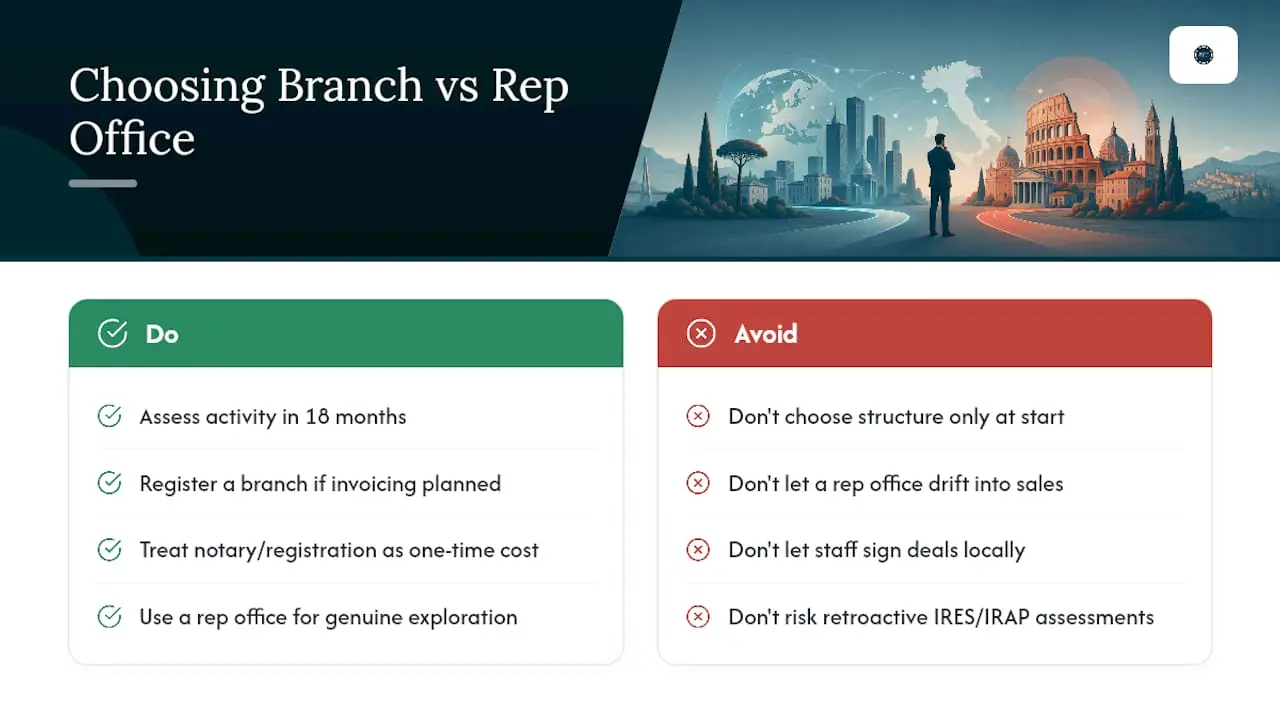
A lot of foreign companies open a representative office because it’s cheaper and faster, then quietly let it drift into commercial territory as business picks up. That drift is where the real damage happens, not in the initial choice of structure. Retroactive IRES and IRAP assessments hurt far more than the incremental cost of registering a branch correctly from day one would have.
If your five-year plan clearly includes invoicing Italian customers, the representative office is a false economy. Register the branch now, and treat the notarial and registration steps as a one-time cost against years of clean compliance. If your Italian presence is genuinely exploratory, the representative office is the right call, but only if you’re disciplined about keeping local staff away from anything resembling a signature on a deal.
— Living
Get Notarial Support for Your Italian Market Entry
Choosing between a branch and a representative office is a legal decision, but executing it correctly is a notarial one, and that’s the part foreign owners can’t do from another country without help. Notaryinitaly is the alternative to juggling a local law firm, a separate translator, and a notary you’ve never met: Cerini Notary Office handles the deed, the filings, and the document coordination as one remote, English-speaking process.

Whether you’re incorporating a branch, drafting the powers of attorney your local representative will need, or need international contracts and deeds recognized on both sides of the border, this is a firm built specifically for clients who can’t sit across a desk in Milan. Email ngcerini@notaryinitaly.com with the details of your situation, whether it’s a branch registration, a representative office setup, or a document that needs notarizing from abroad, and get a consultation scoped to your exact case.
Sources
- Setting Up an Italian Representative Office vs. Branch Guide | Italy
- Subsidiary vs Branch Italy Tax 2026 | Global Law Experts
- Doing business in Italy: Guide (official/embassy guide excerpt)
- Agenzia delle Entrate — model AA7/10 (tax registration)
Recommended
- SRL vs Branch Italy for Foreign Businesses – Notary in Italy
- Company Incorporation in Italy for Foreign Investors | Notary in Italy
- Italian Company Formation for Foreign Investors
- How to Open a Company in Italy as a Foreigner – Notary in Italy
The information provided here is general in nature and does not replace professional assistance. Reading this content does not create a professional-client relationship.