
Yes, a foreigner can use a power of attorney in Italy, but the document has to meet Italian form requirements under Article 1392 of the Civil Code, which means the POA must match the legal form of the act it authorizes. For a straightforward bank mandate, a private signature might work. For a property purchase, it usually needs to be a notarial public deed.
You have two valid routes to get there:
- Consular execution: sign the power of attorney at an Italian consulate, which can issue it directly as a public deed, though this option is far more limited for non-citizens than for Italian nationals.
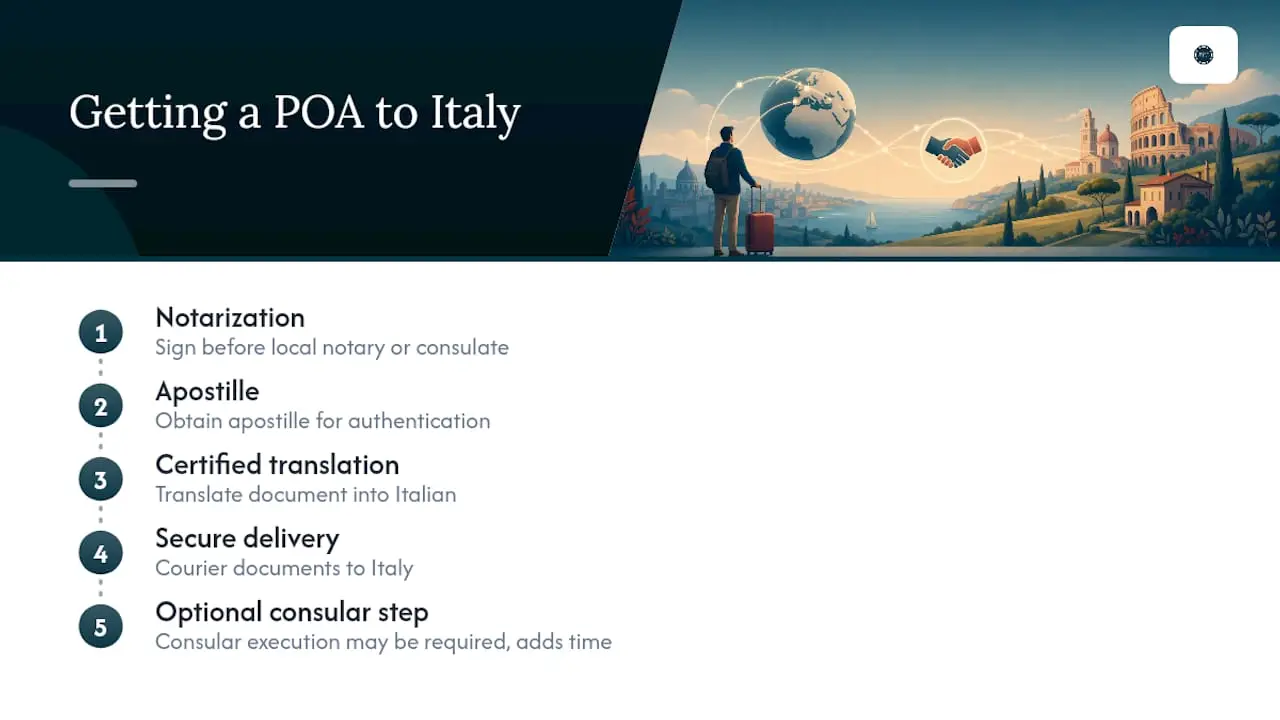
- Foreign notary route: sign before a notary in your home country, obtain an apostille (or legalization, if your country is outside the Hague Convention), then have the document translated into Italian by a certified translator.
Either path can work. The one that fails is guessing. Before you sign anything, contact an English-speaking Italian notary, such as Cerini Notary Office, to confirm exactly which form your specific transaction requires. Getting this wrong after the fact means re-executing the whole document, and that can cost you a closing date.
Key Takeaways
A valid Italian power of attorney must satisfy Article 1392’s form symmetry rule, meaning property transactions require a notarial public deed rather than a generic private-signature document.
| Point | Details |
|---|---|
| Match the form to the act | Real estate POAs generally need a public deed; broader tasks can use a procura generale. |
| Confirm your execution route early | Consular execution suits Italian citizens; foreign notary plus apostille suits most others. |
| Name the property precisely | Include cadastral references and full address to avoid rejection at the notary or land registry. |
| Budget two to four weeks | Notary, apostille, translation, and courier delivery each add time before your agent can act. |
| Get Italian legal review before signing | Cerini Notary Office drafts and verifies POA wording remotely with full English-speaking support before you execute abroad. |
Table of Contents
- Types of Italian Power of Attorney: Which One Do You Actually Need?
- How to Get Power of Attorney in Italy From Abroad
- Why Property Transactions Need a Notarial Deed, Not a Standard POA
- Document Checklist: What to Prepare for Property, Bank, and Inheritance POAs
- Cerini Notary Office: Executing a Compliant POA Without Setting Foot in Italy
- What Foreign Buyers Consistently Get Wrong About Italian POAs
- Notaryinitaly: Your Direct Path to a Valid Italian Power of Attorney
- Frequently Asked Questions About Power of Attorney in Italy
- Sources
Types of Italian Power of Attorney: Which One Do You Actually Need?
Italian law recognizes a spectrum of authority, and choosing the wrong end of it is one of the most common reasons a POA gets rejected at the notary’s desk. A procura generale (general power of attorney) grants broad authority over a person’s affairs, similar in spirit to what English-speaking countries call a general POA. A procura speciale (special power of attorney) limits the agent’s authority to one specific act, such as signing a single deed for one identified property. There’s also a distinct category, procura alle liti, which authorizes a lawyer to represent you in litigation and follows its own procedural rules under the Italian Code of Civil Procedure.
The type you need depends entirely on the transaction:
- Buying or selling property almost always calls for a procura speciale tied to the exact asset, since Italian notaries want to see the specific cadastral parcel, address, and transaction named in the document itself.
- Managing ongoing affairs (paying a caretaker, handling a bank account, dealing with utilities on an inherited house) fits better under a procura generale, since the agent needs flexibility across multiple small tasks.
- Court proceedings, including inheritance disputes, require the procura alle liti signed in the specific form the court and the Code of Civil Procedure demand.
Vague wording is where most problems start. A property POA that says “to handle matters relating to my Italian real estate” without naming the parcel, address, and transaction type will likely bounce at the notary’s office or the land registry. Italian notaries and registries commonly reject foreign powers of attorney precisely because they’re too broad or skip the notarial form the underlying act requires, and that rejection typically surfaces only after the document has already crossed the ocean. An Italian-drafted procura speciale that names the cadastral references up front avoids that entire problem.
How to Get Power of Attorney in Italy From Abroad
You have two workable paths, and which one applies to you often comes down to your citizenship status. Here’s how each works in practice.
The consular route applies primarily to Italian citizens living abroad. Some consulates, including the Italian Consulate General in London, can execute a public deed directly, which skips the apostille and translation steps entirely. Non-citizens generally can’t use this shortcut. Consular notarial acts move fastest for Italian nationals; foreign nationals typically need the local notary and apostille path instead, so confirm availability with your specific consulate before you plan around it.
The foreign notary route is what most non-Italian property buyers and family members will use:
- Draft the power of attorney, ideally in Italian, or have an Italian notary review an English draft before you sign anything.
- Sign the document before a notary public in your home country.
- Obtain an apostille if your country is a party to the Hague Convention, or seek legalization through the Italian consulate if it isn’t.
- Have the document translated into Italian by a certified or sworn translator; consular guidance for foreign citizens places the translation responsibility on the signer, not the receiving party in Italy.
- Courier the apostilled original and the certified translation together to your Italian notary or agent, since photocopies or scans are rarely accepted for a public deed.
The standard process for foreign citizens outlined by Italian consular authorities confirms this same sequence: draft, notarize locally, apostille, translate.
Pro Tip: Have your Italian notary review the wording before you sign abroad, not after. A ten-minute email exchange with the notary who will actually use the document catches missing cadastral details or vague clauses that would otherwise force a full re-execution weeks later.
One caveat worth repeating: some consulates limit power of attorney services strictly to Italian citizens, and policies vary by country and by consulate. Check the local consulate’s own guidance rather than assuming the London or New York procedure applies everywhere.
Why Property Transactions Need a Notarial Deed, Not a Standard POA
This is where most foreign buyers get tripped up, and it comes down to one rule most general POA templates were never built to satisfy. Article 1392 of the Italian Civil Code establishes what lawyers call the principle of form symmetry: a power of attorney must take the same legal form as the act it’s meant to authorize. Since Italian real estate transfers require a public deed executed before a notary, the power of attorney authorizing someone to sign that transfer generally needs the same notarial form.
Layered on top of that is the lex situs principle: property located in Italy is governed by Italian law, regardless of where the owner lives or holds citizenship. That’s why a US durable power of attorney or a UK Lasting Power of Attorney often fails outright for an Italian property transfer, even though it works perfectly well back home. It wasn’t executed in the form Italian law demands for that specific act.
A property POA that will actually hold up needs:
- The cadastral references (foglio, particella, subalterno) of the specific property, not a general description.
- The full property address, matching the land registry records exactly.
- Key contract details, including the identities of buyer and seller and the transaction type.
- Execution as a public deed, either before an Italian notary, a foreign notary whose act is then apostilled and translated, or an Italian consulate where available.
The most common rejection triggers are vague property descriptions, private-signature documents used for acts requiring notarial form, and missing identifiers linking the POA to the specific parcel. A POA drafted for general use back home almost never satisfies Article 1392 for an Italian property deed, which is why an Italian-tailored procura speciale, not a repurposed foreign template, is the safer route for any real estate transaction.
Document Checklist: What to Prepare for Property, Bank, and Inheritance POAs
The paperwork differs depending on whether you’re closing on a house, opening a bank mandate, or handling an inheritance. Here’s what each scenario typically requires before you ship originals to Italy.
Witness requirements vary by document type and by the notary’s own practice, so confirm this directly with whoever will use the POA in Italy. For property transactions specifically, remember that a public deed is mandatory. A private signature, even a notarized one, generally won’t satisfy Article 1392 for a real estate transfer. Reviewing a step-by-step notarization guide before you start collecting documents can save a second round of couriering originals across the Atlantic.
Realistic Timelines and Costs for Executing a POA
Budget more time than you think you’ll need. From the moment you sign abroad to the moment your agent has a usable document in Italy, the typical timeline runs two to four weeks, covering the local notary appointment, apostille processing, certified translation, and courier delivery. Add extra time if you’re relying on a consular appointment, since availability can stretch out during busy seasons.
Expect these cost categories:
- Foreign notary fees for signing and certifying the document, which vary by country and notary.
- Apostille fees, typically a modest fixed charge through your country’s designated authority.
- Certified translation fees, usually priced per page or per word for legal documents.
- Italian notary fees for reviewing the POA and using it in the underlying transaction.
- Courier costs with insurance, since original apostilled documents shouldn’t travel as ordinary mail.
- Consular fees, if you use that route and it’s available to you.
The single biggest lever for avoiding delays is pre-drafting the Italian wording with your notary before you ever sign abroad. Reserve consular appointments early if you’re going that route, and choose a translator experienced specifically with legal and notarial documents rather than a general-purpose translation service. A mistranslated cadastral reference can cost you another full cycle of apostilles and courier fees.
When a Power of Attorney Ends, and What Happens if You Lose Capacity
A power of attorney in Italy terminates automatically on the principal’s death, on completion of the specific task it authorized, or on formal revocation. Revoking a consular-executed POA generally means notifying the same consulate; revoking a notarized foreign POA means executing a formal revocation, ideally in the same form as the original, and sending certified notice to every Italian recipient who holds a copy, including the notary, bank, or land registry involved.

Here’s where a lot of foreign clients get an unpleasant surprise: a standard procura is not a substitute for a durable power of attorney covering incapacity. Italy’s mechanism for incapacity is called amministrazione di sostegno (support administration), a court-supervised arrangement distinct from the common-law “durable” or “lasting” POA. If you’re planning for the possibility of losing capacity to manage Italian assets, a US or UK-style LPA often won’t transfer into Italian legal effect, and you’ll need separate planning through the Italian court system.
One more risk worth flagging: acts performed by an agent who exceeded their authority can sometimes be ratified after the fact, but that’s a legal remedy, not a plan. Precise drafting up front is cheaper than ratification litigation later.
Cerini Notary Office: Executing a Compliant POA Without Setting Foot in Italy
Getting a power of attorney right on the first attempt is largely a matter of having someone who knows exactly which form your transaction demands, review it before you sign. That’s the core of what Cerini Notary Office does for foreign clients.
The firm handles the pieces that typically trip up a DIY approach:
- Drafting the Italian wording for your procura speciale or procura generale, tailored to the specific transaction rather than a generic template.
- Verifying whether your planned document satisfies Article 1392’s form symmetry requirement before you sign anything abroad.
- Coordinating with foreign notaries and clarifying apostille or legalization requirements for your specific country.
- Arranging certified Italian translation through vetted, legally experienced translators.
- Managing secure courier logistics for original apostilled documents.
- Representing your interests at the Italian notary’s office when the underlying deed is executed.
Cerini Notary Office built its practice specifically around international clients navigating Italian real estate, corporate, and inheritance matters, with remote service delivery and full English-speaking support as standard, not an add-on. That matters most for readers managing a purchase or an inheritance from another country, since it removes the language barrier at exactly the moment precision matters most.
Pro Tip: Send your draft POA to your notary before you book your local notary appointment abroad, not after. Catching a missing cadastral reference by email costs you nothing; catching it after you’ve already paid for an apostille costs you the apostille fee and another two weeks.
If you’re managing a purchase, an inheritance, or an ongoing Italian matter from abroad, reach out to Cerini Notary Office through its remote notary services for guidance specific to your situation.
What Foreign Buyers Consistently Get Wrong About Italian POAs
The conventional advice you’ll find online tends to treat “power of attorney” as a single, portable concept, something you sign once at home and then use anywhere. That framing is the root of most of the rejected documents Italian notaries see. Article 1392 doesn’t care how your POA worked in your home country. It cares whether the document’s form matches the act you’re trying to perform in Italy.
What gets underestimated is how much the wording itself matters, not just the authentication chain. A perfectly apostilled, perfectly translated POA still fails if the underlying text is too broad or omits the cadastral references. Buyers spend their energy chasing apostilles and translators, which are mechanical steps, while underinvesting in the actual Italian legal drafting, which is where judgment matters.
My honest read: draft the document with an Italian notary’s input before you sign anything abroad. Everything else, the apostille, the translation, the courier, is logistics you can execute in sequence. The drafting is the one step you can’t fix after the fact without starting over.
Notaryinitaly: Your Direct Path to a Valid Italian Power of Attorney
Notaryinitaly is the direct alternative to piecing this process together yourself across time zones and language barriers. Instead of coordinating a foreign notary, a translator, and an Italian notary separately, and hoping the wording lines up, you work with one English-speaking firm that drafts the Italian language from the start and knows exactly what your local notary and land registry will expect to see.

This matters most if you’re buying property, settling an inheritance, or setting up a company in Italy while living somewhere else entirely. Notaryinitaly’s remote services mean you don’t need to fly to Italy to get a compliant power of attorney executed, and the firm’s international contracts and deeds services cover the broader legal documentation many cross-border transactions require alongside the POA itself.
If you have a property purchase, inheritance matter, or corporate transaction that needs a compliant power of attorney, contact Cerini Notary Office at ngcerini@notaryinitaly.com for a consultation on your specific case. Send a brief description of the transaction and your country of residence, and the firm will confirm which POA form and execution route apply to you.
Frequently Asked Questions About Power of Attorney in Italy
Can a foreigner grant a power of attorney for Italian property?
Yes. Foreigners routinely grant power of attorney for Italian property purchases, but the document must satisfy Article 1392’s form symmetry rule, meaning it typically needs to be executed as a public deed rather than a simple private signature.
Do I need to travel to Italy to sign a power of attorney?
No. You can sign before a notary in your home country, obtain an apostille, and have the document translated into Italian, or in some cases execute it directly at an Italian consulate if you’re an Italian citizen.
What’s the difference between procura generale and procura speciale?
A procura generale grants broad ongoing authority over your affairs, while a procura speciale limits the agent to one specific, clearly identified transaction, which is what most property purchases require.
Will my home country’s power of attorney work in Italy?
Often not for real estate. A US durable POA or UK Lasting Power of Attorney is frequently rejected for Italian property transfers because it wasn’t executed in the notarial form Italian law requires for that specific act.
How long does it take to get a usable POA to Italy from abroad?
Plan on roughly two to four weeks for the full cycle covering notarization, apostille, certified translation, and secure courier delivery, with extra time if a consular appointment is involved.
Does a power of attorney cover me if I become incapacitated?
No. Italy uses a separate court-supervised mechanism called amministrazione di sostegno for incapacity, and a standard power of attorney generally does not substitute for it.
Sources
- Power Of Attorney’s – Consolato Generale d’Italia a San Francisco
- Power of attorney for Italian citizens – Consolato Generale d’Italia (London)
- Power of Attorney in Italy: Types, Costs and Process – LegalClarity
- Power of attorney for foreign citizens – Consolato Generale d’Italia a New York
Recommended
- Power of Attorney for Buying Property in Italy – Notary in Italy
- Is a US Power of Attorney Valid in Italy? – Notary in Italy
- talian Notarial Power of Attorney | Foreign Investors
The information provided here is general in nature and does not replace professional assistance. Reading this content does not create a professional-client relationship.