
For official use in Italy, a sworn translation (“asseverazione”) is the form that carries legal weight with public bodies. A plain “certified” translation produced in another country is often insufficient on its own, no matter how professionally it was prepared. Italian registries, courts, and consulates work from a civil-law framework, and that framework names asseverazione specifically, with roots in D.P.R. 445/2000, article 33.
Before you order any translation, check three things:
- Confirm with the receiving Italian authority whether it requires asseverazione or will accept a simpler certified translation.
- If asseverazione is required, arrange it with a translator recognized in Italy, or have a notary coordinate the process for you.
- Ask about timing early. Sworn translations generally take longer and cost more than private certified translations, since they involve a court or notarial appointment rather than a translator’s signature alone.
Skipping this verification step is the single most common reason foreign documents get bounced back at the counter.
Key Takeaways
A sworn translation carries legal weight with Italian authorities that a foreign certified translation generally does not, and confirming the receiving office’s exact requirement before ordering any translation prevents the most common and costly rejections.
| Point | Details |
|---|---|
| Sworn beats certified for Italy | Asseverazione, not a foreign certified translation, satisfies most Italian public bodies. |
| Confirm requirements in writing | Ask the receiving authority whether they need asseverazione or will accept another format. |
| Legalization is a separate step | Apostille or legalization of the original may be required before or after translation. |
| Budget extra time and cost | Sworn translations take days to over a week and cost more due to marca da bollo and court fees. |
| Notaryinitaly coordinates the process | An English-speaking notary can confirm requirements, coordinate sworn translators, and manage legalization sequencing. |
Table of Contents
- Sworn vs. Certified Translation: What “Asseverazione” Means in Italy
- Sworn vs. Certified Translation: How Certified Translation Differs
- Sworn vs. Certified Translation at a Glance
- When Do Italian Authorities Require a Sworn Translation?
- How Do You Get a Sworn Translation Done in Italy?
- When Do You Also Need an Apostille or Legalization?
- What Do Sworn and Certified Translations Cost in Italy?
- What Mistakes Cause Sworn Translations to Get Rejected?
- How Can an English-Speaking Notary Help With Sworn Translations?
- A Publisher’s Perspective on Sworn Translation Mistakes
- Get Help Coordinating Sworn Translations and Legalization in Italy
- Frequently Asked Questions
- Sources
Sworn vs. Certified Translation: What “Asseverazione” Means in Italy
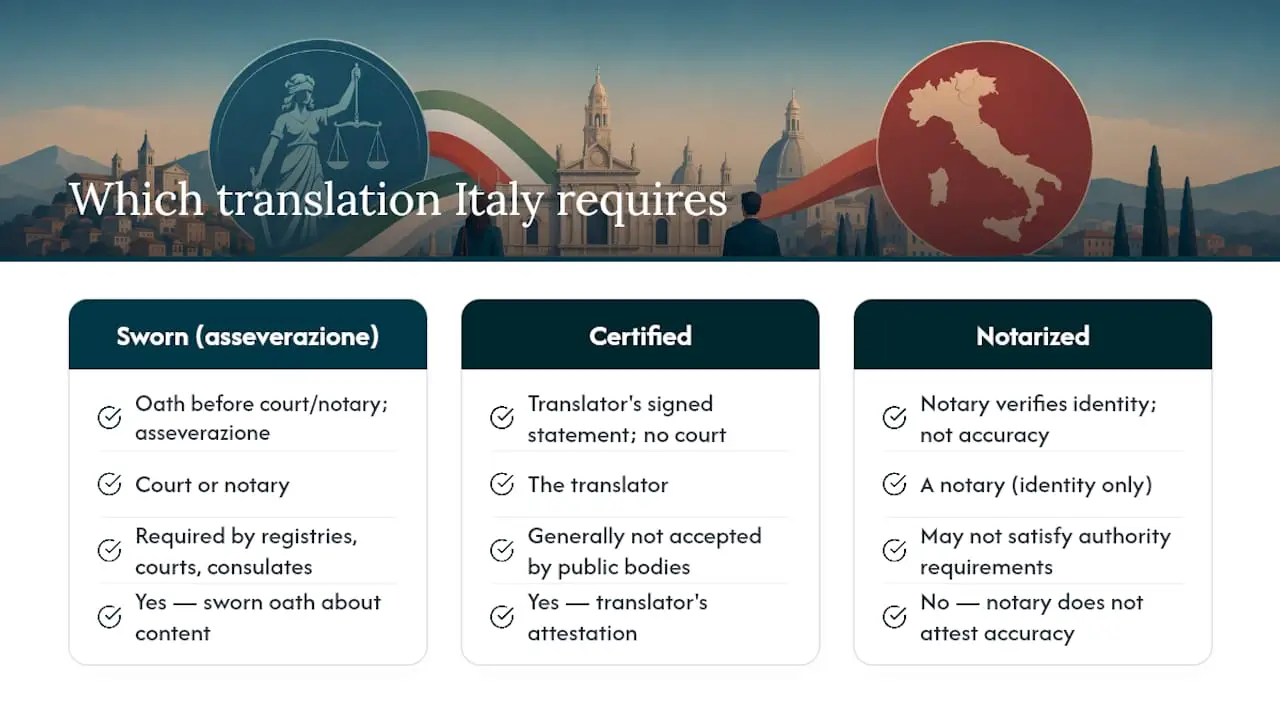
Asseverazione is the process by which a translator swears before a court official or notary that a translation faithfully represents the original document. The translator signs an oath, and the finished package includes a verbale di asseverazione, a stamp, and a signature that Italian public bodies recognize as legally binding.
This isn’t a formality invented by bureaucrats for its own sake. D.P.R. 445/2000 governs how administrative documentation gets accepted in Italy, and its provisions are why registries and courts insist on the sworn format rather than a translator’s letterhead statement.
In practice, three groups handle this work:
- Court-listed expert translators, known as CTU (Consulenti Tecnici d’Ufficio), who appear on tribunal rosters.
- Notaries, who can witness the oath in jurisdictions or situations where a court appointment isn’t practical.
- Local tribunal clerks, who administer the oath and affix the official stamp during the court-based route.
There is no single national register of “sworn translators” in Italy the way some countries maintain one. Instead, each tribunal keeps its own list, and local practice determines whether a notary can substitute for a court oath. That local variation catches a lot of foreign clients off guard.
Sworn vs. Certified Translation: How Certified Translation Differs
A certified translation, in the common-law sense used across the United States, the United Kingdom, and similar jurisdictions, is a translator’s signed statement affirming the translation’s accuracy. No oath, no court appointment, no government stamp. The translator or agency simply attests, on their own authority, that the work is faithful to the source.
This model works fine domestically in common-law countries, where a translator’s professional certification generally satisfies receiving institutions. It is also a recognized international standard with a long track record. The problem is that civil-law countries, Italy included, typically want something with a stronger evidentiary basis: a sworn statement made before a judicial or notarial authority, not a private attestation.
- A certified translation can be useful for preliminary reviews, internal due diligence, or non-official submissions where formality isn’t required.
- It rarely substitutes for asseverazione once a document needs to go before an Italian registry, court, or consulate.
Pro Tip: If you already have a certified translation from your home country, don’t assume it’s usable in Italy. Confirm with the receiving office whether it needs to be re-done as a sworn translation or supplemented with additional legalization before you submit anything.
Sworn vs. Certified Translation at a Glance
The two formats diverge sharply once you look at how Italian authorities treat them.
| Dimension | Sworn Translation (Asseverata) | Certified Translation |
|---|---|---|
| Legal formality / acceptance in Italy | Recognized as legally equivalent to the original for official use | Generally not accepted alone for registries, courts, or consulates |
| Who performs or validates it | Court-listed CTU translator or notary-witnessed oath | Professional translator or agency, self-attested |
| Typical procedure | Oath before tribunal or notary, verbale, stamp, marca da bollo | Signed statement of accuracy, no oath |
| Apostille/legalization needed | Often yes, on the original before or after translation | Sometimes, but rarely resolves Italian acceptance on its own |
| Cost and turnaround | Higher cost, days to over a week | Lower cost, often 24 to 48 hours |
A birth certificate destined for an Italian civil registry almost always needs the sworn route. A diploma submitted for a preliminary university inquiry might get by on a certified translation. A court judgment being introduced into Italian litigation will need asseverazione, full stop.
When Do Italian Authorities Require a Sworn Translation?
Certain institutions are consistent about demanding asseverazione, and knowing the pattern saves you a wasted trip.
- Anagrafe (civil registry offices), for birth, marriage, and death certificates used in residency or civil-status filings.
- Tribunals and courts, for any document entering litigation, including judgments, contracts, and evidentiary records.
- Italian consulates abroad, when processing citizenship applications or civil-status recognition.
- Inheritance proceedings, where foreign wills, death certificates, or estate documents must be translated for succession filings.
- Property transactions, where deeds, powers of attorney, or corporate documents from abroad require sworn translation before a notarial act can proceed.
The receiving office’s instruction is the deciding factor here, not general assumptions about what “should” work. Ask them directly, in writing if possible, and reference the exact term they use, since “asseverazione” and “traduzione giurata” both point to the sworn format. Documents tied to notarized deeds or property filings tend to follow the strictest interpretation of this rule.
How Do You Get a Sworn Translation Done in Italy?
The process has a fixed sequence, and skipping a step usually means starting over.
- Verify the requirement. Contact the receiving authority and ask specifically whether they need asseverazione or will accept another format.
- Select a translator or notary contact. Choose someone recognized by an Italian tribunal, or work with a notary who can coordinate the process on your behalf.
- Translation drafted. The translator produces the Italian version of your document.
- Oath performed. The translator swears before the competent court clerk or notary that the translation is accurate.
- Verbale and stamp attached. The verbale di asseverazione, official stamp, and any required marca da bollo (revenue stamp) get affixed to the finished package.
- Certified copy returned. You receive the completed sworn translation, ready for submission.
Before you start, gather these items:
- The original document, plus a certified copy if the authority requests one.
- Any existing apostille or legalization already applied to the original.
- Valid identification for the translator or notary handling the oath.
- Payment for marca da bollo and any court administrative fees.
Pro Tip: Court appointment availability varies by tribunal, and local scheduling can add several days to your timeline. If you’re working against a deadline, ask your translator or notary about notary-witnessed alternatives to a full court appointment, which are accepted in many jurisdictions when tribunal slots are tight.
Notaries can often substitute for the court oath when local practice allows it, which is worth asking about upfront rather than after you’ve already booked a tribunal slot.
When Do You Also Need an Apostille or Legalization?
Translation and legalization are two separate steps, and mixing up their order is a frequent source of rejected filings. If your original document was issued abroad, it may need an apostille or full legalization before any translation happens, since the apostille authenticates the original, not the translation.
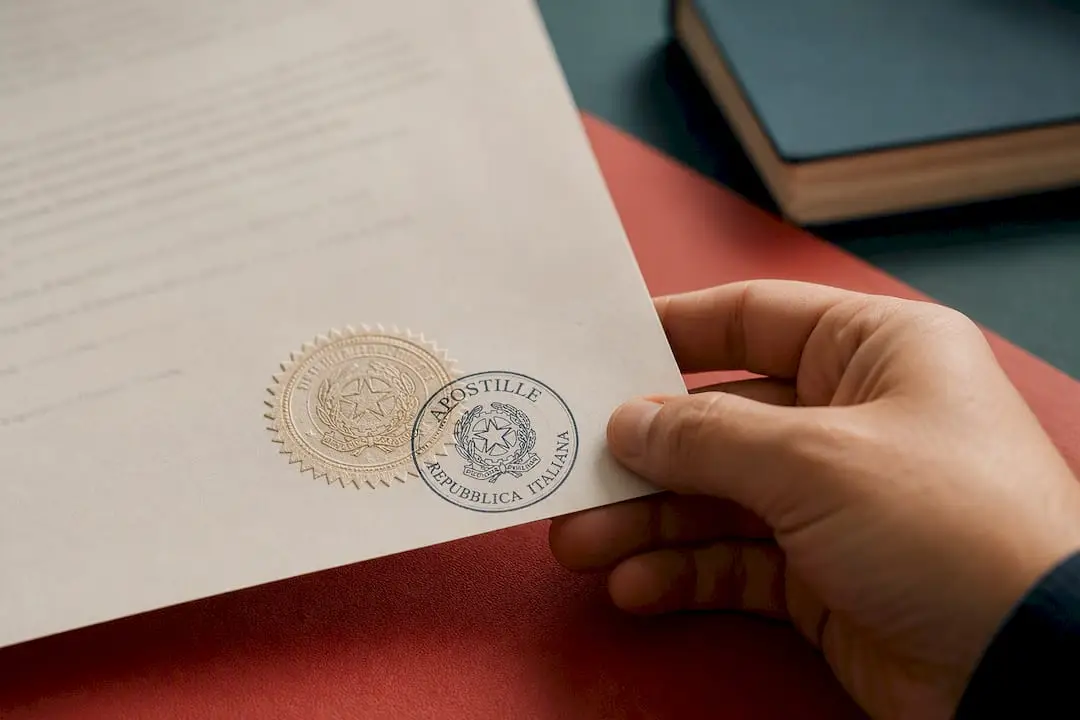
In some cases, the sequence runs the other way. The finished sworn translation package itself may need legalization once it’s complete, depending on where it’s headed and what the receiving office expects. Italian government guidance draws a clear line between these two formalities, and conflating them is exactly the kind of mistake that stalls a filing for weeks. Always confirm with the receiving office which order applies to your document before you schedule anything.
What Do Sworn and Certified Translations Cost in Italy?
Certified translations from private agencies typically move fast, often ready within 24 to 48 hours, with pricing based on page count or word volume.
Sworn translations take longer because of the administrative layer involved: court appointment availability, marca da bollo fees, and the oath itself. Turnaround commonly runs from several days to more than a week, depending on tribunal scheduling in your area.
- Certified translation: lower per-page cost, no court fees, fastest turnaround.
- Sworn translation: higher overall cost due to marca da bollo and administrative steps, longer turnaround tied to appointment availability.
Budget for the sworn route whenever an Italian public body is the end recipient. The extra cost is smaller than the cost of resubmitting after a rejection.
What Mistakes Cause Sworn Translations to Get Rejected?
Most rejections trace back to the same handful of errors.
- Submitting a foreign certified translation and assuming an Italian registry will treat it as equivalent to asseverazione. Practitioners describe this as a jurisdictional mismatch: the destination authority decides the format, not the sender’s home country conventions.
- Skipping legalization or apostille on the original document when the receiving office requires it before translation.
- Assuming any translator’s stamp automatically equals legal validity, without confirming the specific court or notarial procedure that applies locally.
Pro Tip: Get the authority’s requirements in writing before you commission anything, and ask explicitly whether they need the full verbale di asseverazione or will accept a notarized translator statement instead.
How Can an English-Speaking Notary Help With Sworn Translations?
An English-speaking Italian notary can confirm exactly what a given authority requires, coordinate with a court-recognized translator, and witness or organize the asseverazione directly.
- Confirming the receiving office’s exact format requirements before you spend money on the wrong translation.
- Coordinating with sworn translators and handling marca da bollo filings.
- Advising on apostille and legalization sequencing for documents originating abroad.
Pro Tip: Routing everything through one notarial point of contact avoids the mismatched paperwork that trips up clients who juggle a translator, a court clerk, and a consulate separately.
A Publisher’s Perspective on Sworn Translation Mistakes
The most frequent error we see isn’t ignorance of the law. It’s confidence in a foreign certified translation that simply doesn’t map onto Italian requirements. Confirming the receiving office’s exact wording early, before you pay for any translation, saves weeks.
Use one point of contact, a notary or local translator, rather than juggling multiple parties. Keep every piece of attestation paperwork: the verbale, the marca da bollo receipt, the translator’s stamp. You’ll need the full set when you submit.
Get Help Coordinating Sworn Translations and Legalization in Italy
Notaryinitaly is the alternative to piecing this process together yourself across a translator, a tribunal clerk, and a consulate in three different time zones. As an English-speaking notarial office serving international clients, Notaryinitaly confirms exactly what your receiving authority requires, coordinates with court-recognized translators for the asseverazione, and handles the legalization sequencing so nothing arrives out of order.

This matters most when the document in question is tied to something with real stakes: an inheritance filing, a property deed, or a set of international contracts that need to hold up in Italian courts. Notaryinitaly’s notarial services for international successions already build sworn translation coordination into the workflow, so foreign heirs and buyers aren’t left guessing about formats. If you’re preparing documents for Italian submission, reach out to confirm requirements and get a quote tailored to your specific filing before you commission any translation.
Frequently Asked Questions
What is the difference between sworn and certified translation?
A sworn translation involves an oath before a court or notary, resulting in a verbale di asseverazione and official stamp. A certified translation is simply a translator’s signed statement of accuracy, without judicial or notarial involvement.
What is sworn translation used for in Italy?
Sworn translation is required for documents submitted to Italian registries, courts, consulates, and notarial offices, including birth certificates, court judgments, diplomas used for official recognition, and inheritance documents.
Is a certified vs. notarized translation the same thing in Italy?
No. A notarized translation, in the common-law sense, means a notary verified the translator’s identity and signature, not the translation’s accuracy. Asseverazione is a distinct Italian procedure involving a sworn oath about the content itself.
When do you need asseverazione instead of a certified translation?
Whenever an Italian public authority, court, or registry requires the document, since these bodies generally need the sworn format rather than a translator’s private attestation of accuracy.
Do sworn translations always need an apostille too?
Not always, but frequently. If the original document was issued abroad, it often needs legalization or an apostille before or after the sworn translation is completed, depending on the receiving office’s specific rules.
This article is general information, not a substitute for advice from a qualified lawyer. Consult a qualified legal professional about your own circumstances before acting on anything here.
Sources
- Certified vs. Sworn Translations: Understanding the Differences for Legal Professionals – Lexology
- Italian government: guidance on document legalization and apostille
- Certified translation — Wikipedia